
Dumbbells for Strength Training Build Real Strength and Fix Imbalances

Introduction: Cut Through the Noise – Build Real Strength with Dumbbells
Let’s be real for a second. The fitness world is loud. Everywhere you look, someone is telling you a different secret to getting stronger. It is easy to feel stuck or even give up before you start.
But the answer to building real strength does not have to be complicated. In fact, one of the most effective tools has been around for decades. That tool is dumbbells for strength training.
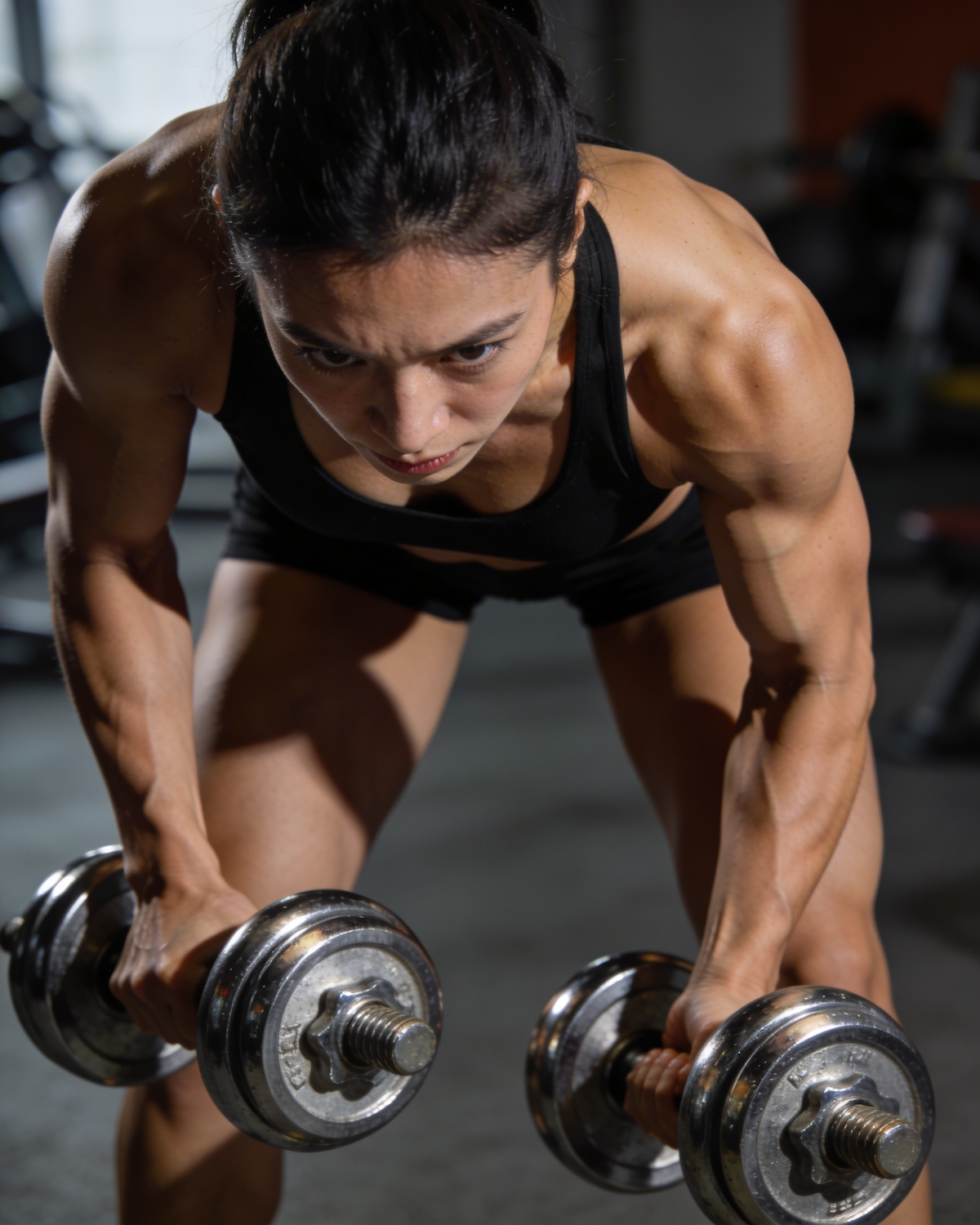
Why dumbbells? Because they work with your body, not against it. Machines lock you into one path, but dumbbells let you move naturally. When you press a dumbbell overhead or squat with one in each hand, your entire body has to work together to keep you balanced. This builds a more functional and resilient kind of strength.
Science backs this up. Research comparing dumbbells to barbells shows that dumbbells activate your stabilizing muscles in a unique way. One study found that the dumbbell bench press creates different demands on your muscles compared to a barbell, which helps you build better overall control and stability [cite PMC study].
Dumbbells also let you train one side of your body at a time.

This is called unilateral training, and it is a game changer for fixing muscle imbalances. If you are a runner looking to add strength training with running, dumbbells are perfect because they strengthen your core and correct the small weaknesses that lead to injury.
This article is your guide to cutting through the noise. You will learn exactly which dumbbell exercises for strength training deliver the best results. You will also find out how to pair strength training and women for health, confidence, and performance.
Ready to stop searching and start training? Let’s find the perfect strength training dumbbells for your home gym.
[Check out RepCore’s trusted recommendations for the best dumbbells to get started on your strength journey]
Why Dumbbells? The Evidence for Unilateral Strength and Stability
When you grab a pair of dumbbells, something interesting happens. Your body can’t cheat the way it can with a barbell. Each arm or leg has to work on its own. That is the magic of unilateral training.
Most people have a stronger side. Maybe your right arm lifts more than your left. Over time, that imbalance can cause bad posture or even injury. Dumbbells fix this by forcing each side to pull its own weight. Research shows that exercises like the dumbbell bench press create a different pattern of muscle activation compared to the barbell version, especially in the triceps [cite the PMC study on muscle activation between barbell and dumbbell press]. This difference helps your stabilizer muscles fire up, which builds more balanced strength.
Dumbbells also give you a greater range of motion. Think about a bench press. With a barbell, the bar hits your chest and you cannot go any lower. But with dumbbells, you can let the weights drop a bit past your chest line. That extra stretch at the bottom recruits more muscle fibers, especially in your pecs and shoulders. More fibers working means more strength gains over time.
And here is the thing about your shoulders. Many people avoid barbell bench press because it hurts their shoulder joints. Dumbbells are much kinder here. Because each dumbbell moves independently, your shoulders can follow their natural path. A study on dumbbell vs. barbell bench press found that the dumbbell version places less stress on the front of the shoulder, making it a safer choice for long-term shoulder health [cite the Colorado Mesa hypothesis PDF, or the CSBSJU PDF showing EMG differences]. You get the chest and triceps activation you want without the ache.
For runners, this shoulder-friendly training is a bonus. Pairing dumbbells with your running routine helps strengthen your core and correct the tiny imbalances that lead to shin splints or hip pain.
That is why strength training with running works so well when dumbbells are involved.
So if you are serious about building real, lasting strength, dumbbells should be your go-to tool. They correct imbalances, improve stability, and protect your joints. To get started with the right gear, check out the top-rated adjustable dumbbells for 2026 that make it easy to progress from light to heavy weight as you grow stronger.
With dumbbells, every rep builds control. That is the kind of strength that transfers to everything you do.
Top 5 Evidence-Based Dumbbell Exercises for Maximal Strength Gains
Now that you know why dumbbells are so effective for building balanced strength, let’s get to the fun part. The actual exercises.
You do not need a long list of fancy moves. In fact, the best dumbbell exercises for strength training are often the simplest ones. The 2026 American College of Sports Medicine (ACSM) guidelines, based on 137 systematic reviews, confirm that compound movements give you the most bang for your buck (https://acsm.org/resistance-training-guidelines-update-2026/).
These exercises work multiple muscle groups at once. That means more strength in less time.
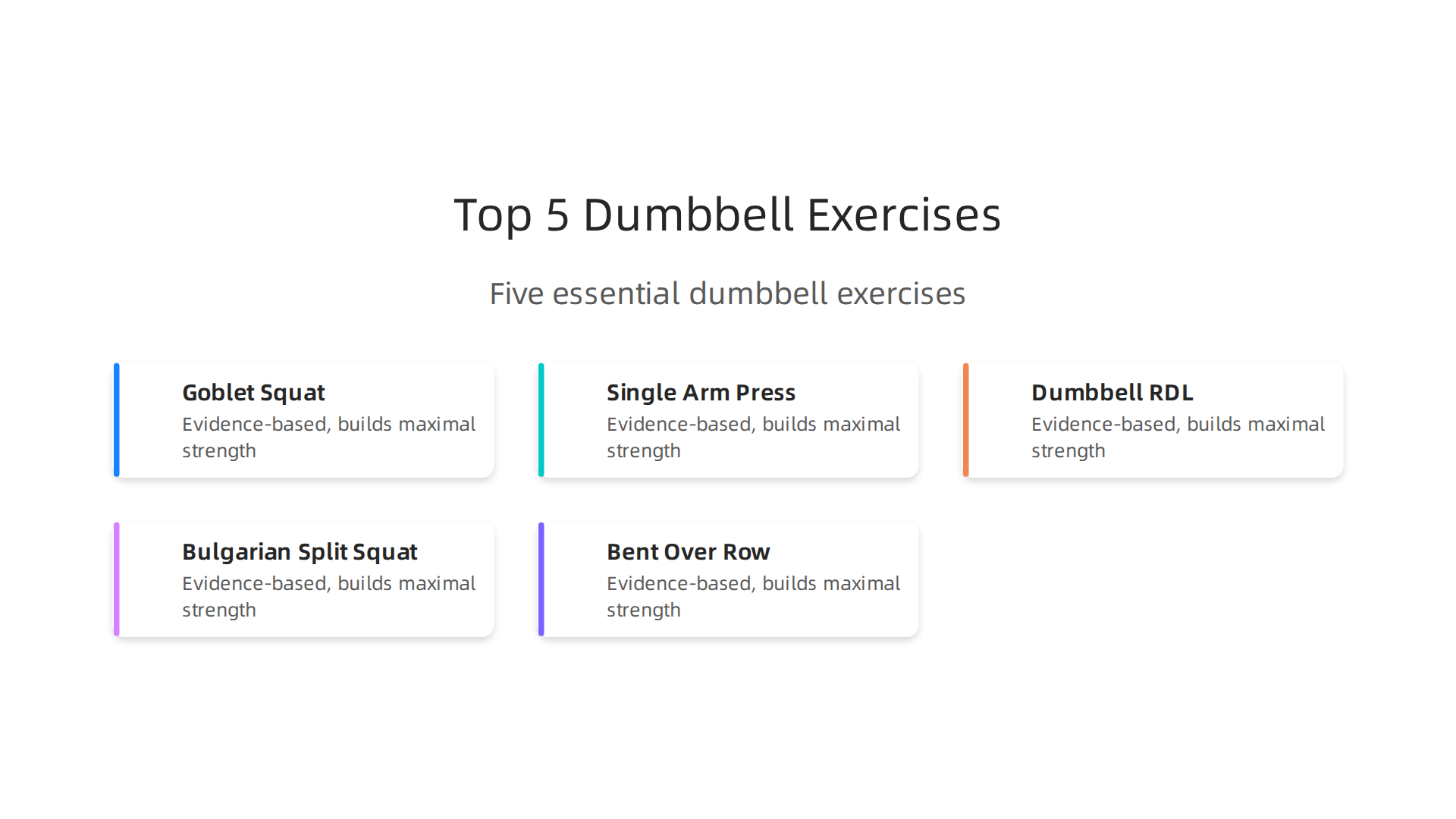
Here are the top five evidence-based dumbbell exercises you should put into your routine.
1. Dumbbell Goblet Squat
This is the King of lower body strength for a reason. Holding one dumbbell against your chest forces your core to work hard to keep you upright. Your quads, glutes, and hamstrings all fire up together. A big plus? This squat pattern is very friendly on your knees and lower back.
To do it: Hold one end of a dumbbell with both hands at your chest. Keep your elbows pointed down. Squat down as low as you can while keeping your chest up. Push through your heels to stand back up. This is a top pick in many dumbbell exercises for strength training guides (https://www.garagegymreviews.com/best-dumbbell-exercises).
2. Single Arm Dumbbell Bench Press
You already know why unilateral work is important. This exercise brings that lesson to life. Lying on a flat bench with one dumbbell in one hand forces your stabilizer muscles to kick in to keep the weight steady. It also helps fix strength imbalances between your left and right sides.
Do this move slowly. Control the weight on the way down. Explode up on the way up. This single arm approach is also gentler on your shoulders than a barbell press. That makes it a standout compound move in any routine focused on strength training dumbbells.
3. Dumbbell Romanian Deadlift (RDL)
This is the best exercise for your hamstrings and glutes. The dumbbell RDL is simple. Stand with your feet hip width apart. Hold a dumbbell in each hand in front of your thighs. Hinge at your hips, pushing your butt back. Keep a flat back as the dumbbells travel down your shins. You will feel a deep stretch in your hamstrings.
The dumbbell version allows each leg to work independently, which is fantastic for fixing muscle imbalances that can cause lower back pain. The ACSM guidelines highlight that nontraditional training, including exercises like the RDL, is highly effective for building strength (https://www.medicalnewstoday.com/articles/new-resistance-training-guidelines-debunk-myths-stronger-muscles-strength-size).
4. Bulgarian Split Squat
This move is a total game changer for your legs and glutes. Place the top of one foot on a bench behind you. Hold a dumbbell in each hand. Lower your back knee toward the ground without letting your front knee go past your toes.
This single leg exercise forces your standing leg to do almost all the work. It builds massive strength in your quads, glutes, and hamstrings. Plus, it improves your balance and stability. That is why it is a mainstay in dumbbells for strength training programs.
5. Dumbbell Bent Over Row
For a strong back, you need rows. The dumbbell bent over row targets your lats, rhomboids, and traps. Hinge forward at your hips with a flat back. Hold a dumbbell in each hand. Pull the dumbbells to your lower ribcage. Squeeze your shoulder blades together at the top.
This compound lift builds the pulling strength you need for running, climbing, and daily life. The ACSM position stand confirms that resistance training, including rows, significantly improves muscle strength (https://pmc.ncbi.nlm.nih.gov/articles/PMC12965823/).
Putting It All Together
These five exercises cover your whole body. They are compound moves first, with unilateral work built in to fix imbalances. You can cycle them into a full body workout two to three times per week.
To get the most out of these moves, you will need dumbbells that let you add weight as you get stronger. Check out the top rated adjustable dumbbells here to make progressing heavy and easy.
Isolation exercises like bicep curls or tricep extensions have a place. But they should come after your heavy compound lifts. That way, you build the real strength that matters first.
Programming Your Dumbbell Workout: Sets, Reps, and Progressive Overload
You now know the top five exercises. But having a list of moves is not enough. You need a plan. A good program turns good exercises into real results.
The 2026 ACSM guidelines, which analyzed data from over 30,000 participants, give us clear numbers to work with (https://pmc.ncbi.nlm.nih.gov/articles/PMC12965823/). How you set up your sets and reps depends on your main goal.
Strength vs. Hypertrophy: Two Different Paths
Your goal decides your rep range.
Here is a simple breakdown:
| Goal | Sets | Reps | Rest Between Sets |
|---|---|---|---|
| Pure strength (neural adaptation) | 3 to 5 | 3 to 6 | 3 to 5 minutes |
| Muscle growth (hypertrophy) | 3 to 4 | 8 to 12 | 60 to 90 seconds |
For dumbbells for strength training, stick to the left column. Heavy loads with low reps train your nervous system to recruit more muscle fibers. This is how you get stronger without necessarily getting bigger.
If you want bigger muscles, the middle column is your sweet spot. More reps with moderate weight creates metabolic stress that drives muscle growth. You can combine both approaches in the same program by starting with heavy compound lifts and finishing with higher rep isolation work.
Progressive Overload: The Secret Sauce
Your body adapts fast. If you do the same workout every week, you will stop seeing progress. That is where progressive overload comes in.
Progressive overload simply means making your workout harder over time. There are four main ways to do this:
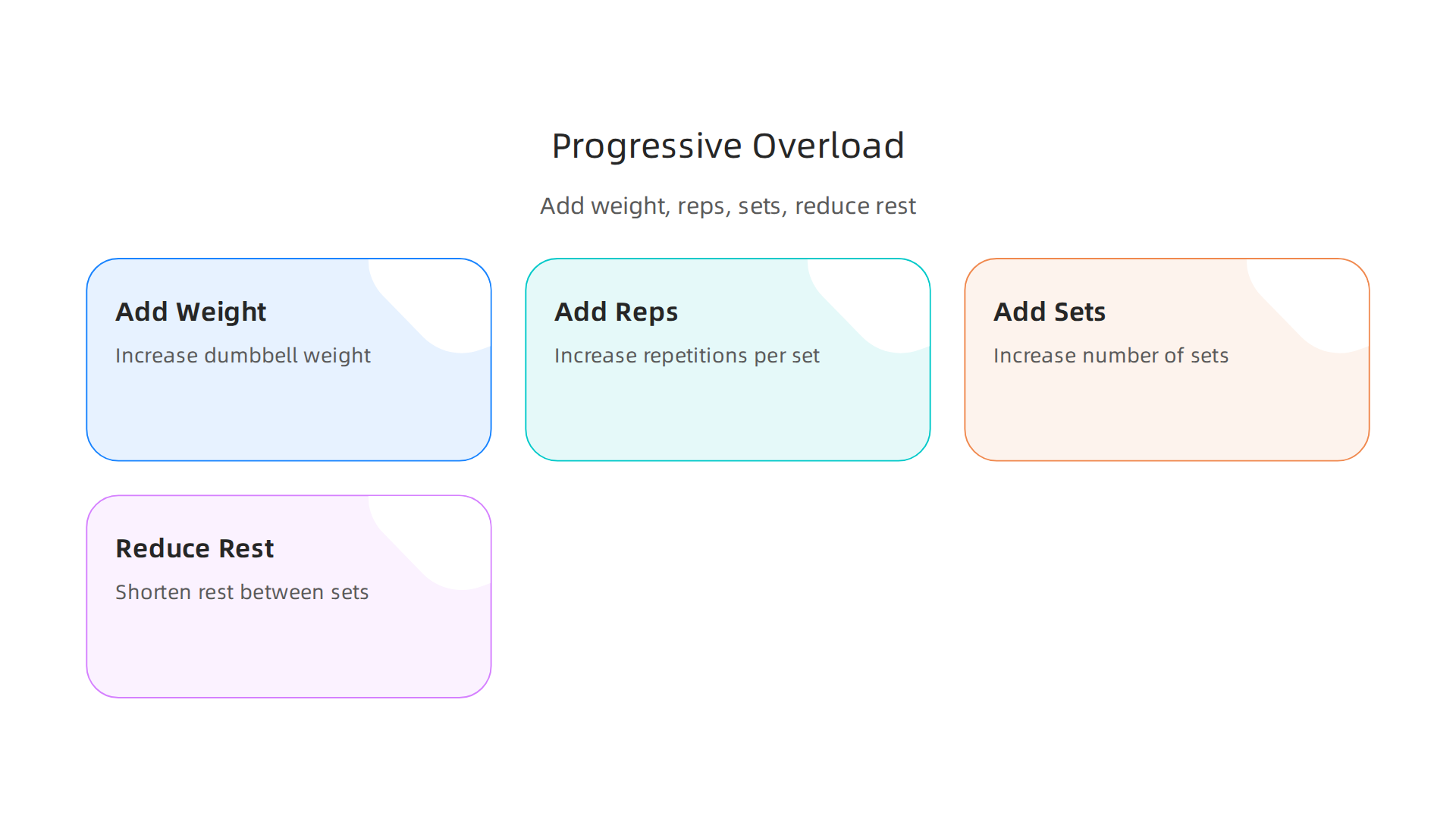
- Add weight. The most obvious method. Lift heavier each week or two.
- Add reps. If you cannot add weight yet, do one or two more reps per set.
- Add sets. Add an extra set to each exercise.
- Reduce rest. Cut your rest time by 15 seconds between sets.
The ACSM guidelines confirm that progressive overload is essential for continued strength gains (https://www.medicalnewstoday.com/articles/new-resistance-training-guidelines-debunk-myths-stronger-muscles-strength-size). Without it, you plateau.
For dumbbell exercises for strength training, adding weight is often the best option. That is why having the right equipment matters so much. To make progress easier, a set of adjustable dumbbells lets you increase weight in small steps without buying a whole new rack. Check out the top rated adjustable dumbbells here to support your progressive overload journey.
Deload Weeks and Periodization
Pushing hard every week is tempting. But your body needs recovery to grow stronger.
A deload week is a planned week where you reduce your weight and volume by 40 to 60 percent. You still train, but with much less intensity. This allows your muscles, joints, and nervous system to fully recover.
Experts recommend taking a deload week every 4 to 8 weeks. After 8 to 12 weeks of consistent training, consider cycling into a different phase. For example, spend 8 weeks on strength (heavy weight, low reps) followed by 4 weeks on hypertrophy (moderate weight, higher reps). This variety prevents boredom and keeps your body adapting.
The best dumbbells for strength training programs always include planned recovery. Do not skip it. Your gains depend on it.
Now you have the exercises and the programming. Next, we will look at how to build a full weekly routine that combines these principles into a simple, effective schedule.
Common Mistakes That Sabotage Your Dumbbell Strength Progress
You have a great plan from the last section. You know your sets, reps, and progressive overload. But even with the best program, a few common mistakes can stop your gains or worse, cause an injury.
Let’s fix them before they become bad habits.
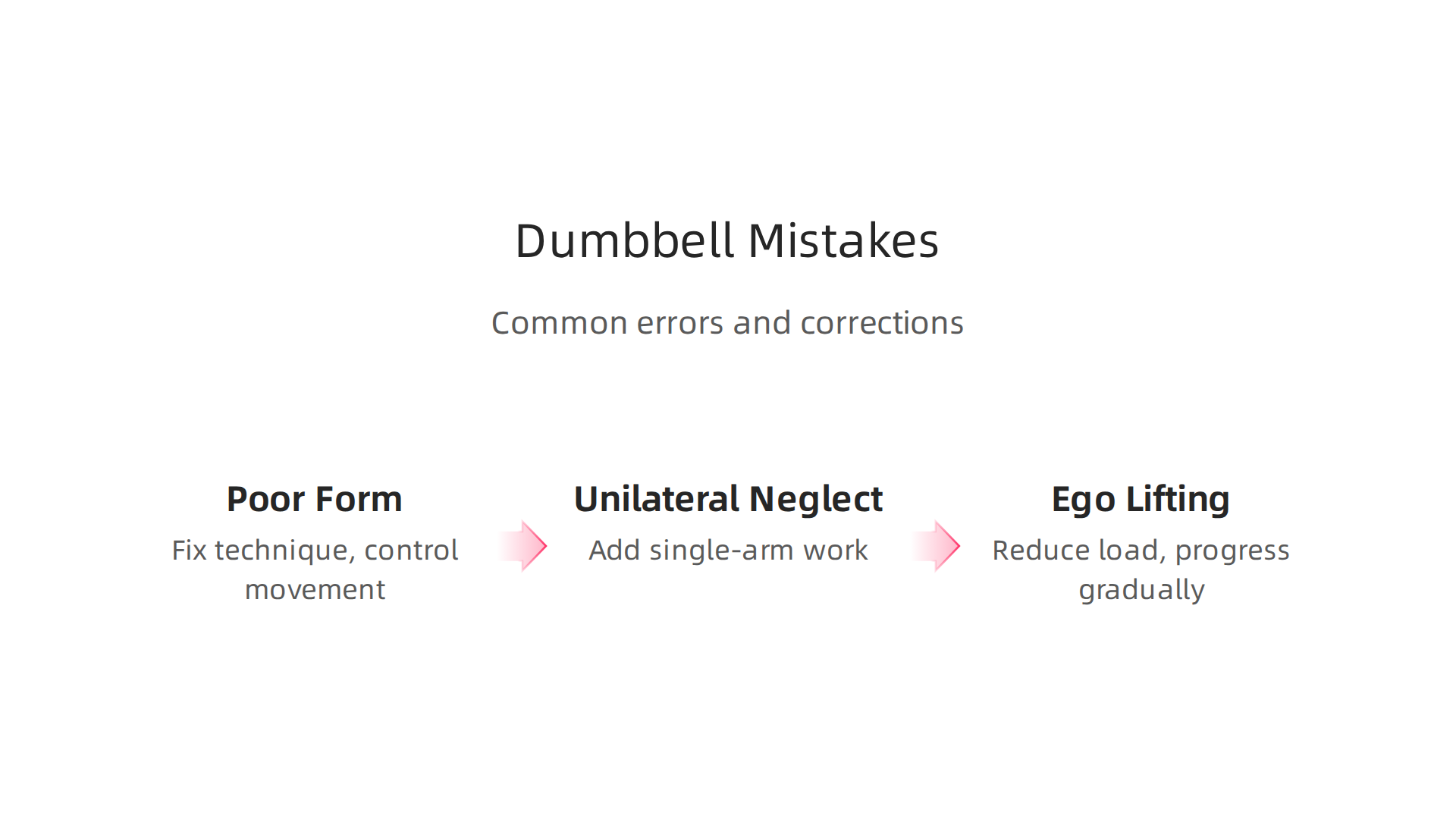
Mistake 1: Poor Form That Steals Your Gains
The biggest mistake people make with dumbbells for strength training is bad form. Two big ones to watch for are arching your back during dumbbell bench press and rounding your shoulders during rows.
When you arch your back too much on the bench, you take the work off your chest and put stress on your lower back. When you round your shoulders on rows, you lose tension in your back and risk shoulder strain. Over time, these small form errors add up to big problems.
Experts point out that flaring your elbows straight out to the sides during presses also puts stress on your shoulder joints source. Another common mistake is bending your wrists under heavy weight, which can lead to wrist pain over time source.
The fix is simple. Always start with a weight you can control. Use a mirror or record yourself. If your setup slips, drop the weight by ten pounds and focus on perfect reps. Good form is not optional. It is the foundation of all dumbbell exercises for strength training.
Mistake 2: Neglecting Unilateral Work
Most people grab a dumbbell in each hand and lift both arms at the same time. That is fine, but it hides a hidden problem. Everyone has a stronger side. If you only train both sides together, your stronger side does more work. Your weaker side never catches up.
Unilateral exercises fix this. Doing moves like single arm rows, single leg squats, or single arm overhead presses forces each side to work alone. This exposes muscle imbalances and corrects them over time. A balanced body is a stronger body.
If you are already doing strength training with running or other sports, unilateral work also improves stability and reduces injury risk. Do not skip it. Add at least one single arm exercise to every workout.
Mistake 3: Using Too Heavy Weights Too Soon (And Not Tracking Progress)
Ego lifting. It happens to everyone. You grab a heavier dumbbell than you can handle because you want to feel strong. But lifting too heavy too soon is one of the most common mistakes people make source. When the weight is too big, your form breaks down, and you stop working the right muscles.
At the same time, many people never track their workouts. They just show up and lift the same weight every week. That means zero progressive overload. No overload means no progress.
To avoid this, pick a weight where you can do all your reps with perfect form. Track your sets, reps, and weight in a notebook or an app. Then increase weight or reps each week in small steps. A good set of adjustable dumbbells makes this easier because you can add tiny increments instead of jumping up five or ten pounds. Check out the top rated adjustable dumbbells here to support your steady progress.
Fix these three mistakes, and your strength training dumbbells routine will finally deliver the results you earned.
Recovery and Nutrition: Fueling Strength Gains from Dumbbell Training
You fixed your form. You started tracking your lifts. But if you still feel stuck or sore all the time, you might be missing the two biggest pieces of the puzzle: recovery and nutrition.
Here is the thing. You do not build muscle when you lift. You build muscle when you rest and refuel. If you want real results from your dumbbells for strength training, you need to pay attention to what happens outside the gym.
Fuel Up with Protein
Let us start with protein. Think of it as the building block for every muscle you are trying to grow. After a tough workout, your muscle fibers break down. Protein helps them repair and come back stronger.
How much do you need? Experts recommend a daily intake of about 1.6 to 2.2 grams of protein per kilogram of body weight for people who are serious about strength. For a 180 pound person, that is roughly 130 to 180 grams of protein each day source source. That is more than most people think.
Timing also matters. Your body repairs muscle while you sleep. Consuming protein before bed gives your muscles a steady supply of building blocks through the night. This reduces muscle breakdown and helps you wake up less sore source source. A simple shake or a cup of cottage cheese before sleep can make a real difference source. If you struggle to hit your protein goals, a high quality supplement can help. Check out top rated recovery supplements here to support your muscle repair.
Sleep Is Your Secret Weapon
You cannot out train a bad sleep schedule. Sleep is when your body releases growth hormone and repairs damaged tissue. If you are sleeping less than seven hours a night, your strength gains will slow down. Your risk of getting sick or injured also goes up.
Make sleep a priority. Set a consistent bedtime. Keep your room cool and dark. Avoid screens an hour before bed. Good sleep is a secret weapon for anyone serious about strength training dumbbells.
Move Lightly and Take Breaks
Rest does not always mean doing nothing. Active recovery helps reduce soreness without adding stress. Light stretching, walking, or easy yoga keeps blood flowing and helps you feel ready for your next workout.
Another smart move is planning a deload week. Every four to six weeks, cut your weights and volume in half for a week. This gives your joints and nervous system a break. When you come back, you will feel stronger and more energized.
Put It All Together
Here is the full picture for dumbbells for strength training. You lift with good form. You eat enough protein. You get quality sleep. You take easy days seriously. When you put it all together, the results follow. Do not skip the boring stuff. The boring stuff is what works.
Choosing the Right Dumbbells: Fixed vs Adjustable, Weight Range, and Safety
Now that you know how to fuel and rest for strength, let us talk about the tools themselves. Picking the right dumbbells can make or break your progress. The wrong choice leads to frustration. The right choice keeps you consistent and safe.
Fixed vs Adjustable Dumbbells
This is the biggest decision you will make.
Fixed dumbbells are the classic set you see in most gyms. Each dumbbell has a set weight. They are durable, easy to grab, and quick to change between exercises. The downside? They take up a lot of space. A full rack can fill a whole room.
Adjustable dumbbells solve that problem. One set replaces an entire rack. They save space and let you add weight in small steps. Many top models in 2026 offer fast dial or pin systems that let you switch weights in seconds source.

This is a big deal for dumbbells for strength training at home.
Which one is right for you? If you have a home gym with limited space, adjustable dumbbells are usually the smarter choice. If you train in a commercial gym or have a large dedicated space, fixed dumbbells work great.
Pick the Right Weight Range
Your weight range matters more than you think. For home use, a range of 5 to 50 pounds covers most people for the first year of strength training dumbbells. If you are more advanced, look for sets that go up to 80 or 100 pounds.
Many adjustable dumbbells in 2026 come in 50 lb, 80 lb, and even 120 lb options source. Start with a range that covers your working sets for main lifts like rows, presses, and squats. You can always add heavier pairs later.
Safety Features You Should Not Skip
Safety is not just about form. Your equipment matters too. Look for dumbbells with rubber or urethane heads. They protect your floors and reduce noise if you drop them.
Check the handles. Ergonomic, knurled grips help you hold the weight securely even when your hands sweat. For adjustable dumbbells, make sure the locking mechanism feels solid. A loose collar can cause the weight to shift mid rep, which is dangerous.
If you are ready to upgrade your setup, check out these top rated adjustable dumbbells that combine safety, durability, and smart weight ranges. They are a solid investment for anyone serious about building strength at home.
Take your time with this choice. The right dumbbells will be with you for years. Choose wisely and you set yourself up for steady, safe progress.
Summary
This article explains why dumbbells are one of the simplest and most effective tools for building real, balanced strength. It reviews the science favoring unilateral work and greater range of motion, then gives five evidence-based compound dumbbell exercises—goblet squat, single-arm bench press, RDL, Bulgarian split squat, and bent-over row—that cover the whole body. You’ll get clear programming guidance for strength vs. hypertrophy, practical progressive overload strategies, and how to structure deloads and periodization. The guide highlights common mistakes that stall progress (poor form, skipping unilateral work, lifting too heavy) and explains how to fix them. It also covers recovery and nutrition essentials—protein targets and sleep—and how to choose the right equipment, weighing fixed versus adjustable options and safety features. After reading, you’ll know which dumbbell moves to prioritize, how to plan sets and progress, and what gear and recovery habits will keep you safe and improving.





Get practical training, recovery, and nutrition insights in your inbox