
Hypertrophy Training Glutes, The Evidence Based Plan for Stronger Rounder Glutes

Introduction
Have you ever felt frustrated trying to grow your glutes?
You follow workout after workout, but the results just aren’t showing up. Maybe your jeans fit the same, or your lifts have stalled. You are definitely not alone.
Building strong, shapely glutes is one of the most common goals in fitness. But here’s the problem. The internet is flooded with bad advice. Myths about "toning" vs. building muscle, weird exercises that don’t work, and magic supplements that promise fast growth without effort. Most of it is just noise.
This guide is different.
We are cutting through the confusion with real science and practical strategies you can use today. Whether you are focused on hypertrophy training glutes for a bigger, rounder look or strength training glutes to improve your squat and deadlift, you will find clear answers here.
What you will learn:
- How your glute muscles actually work and grow
- The best exercises for maximum development
- How to structure your workouts for real progress
- The nutrition and recovery habits that matter
- Common mistakes that kill your gains
You will also discover practical lower body exercises and glute exercises at home that fit into your real life. No gym required for some of them. This is not just another "best butt workout for women" list. This is a complete system backed by evidence and built for everyday athletes who want results that last.
Ready to finally get the glute growth you have been working for? Let’s start with the basics. Understanding your anatomy is the first step to building muscle that stays.
1. Glute Anatomy and Function: Why Understanding Structure Matters for Growth
Why should you care about anatomy? Because you can’t build what you don’t understand. Your glutes aren’t one single muscle. They are a team of three distinct muscles, and each one has a different job. If you ignore their individual roles, you will leave serious growth on the table.
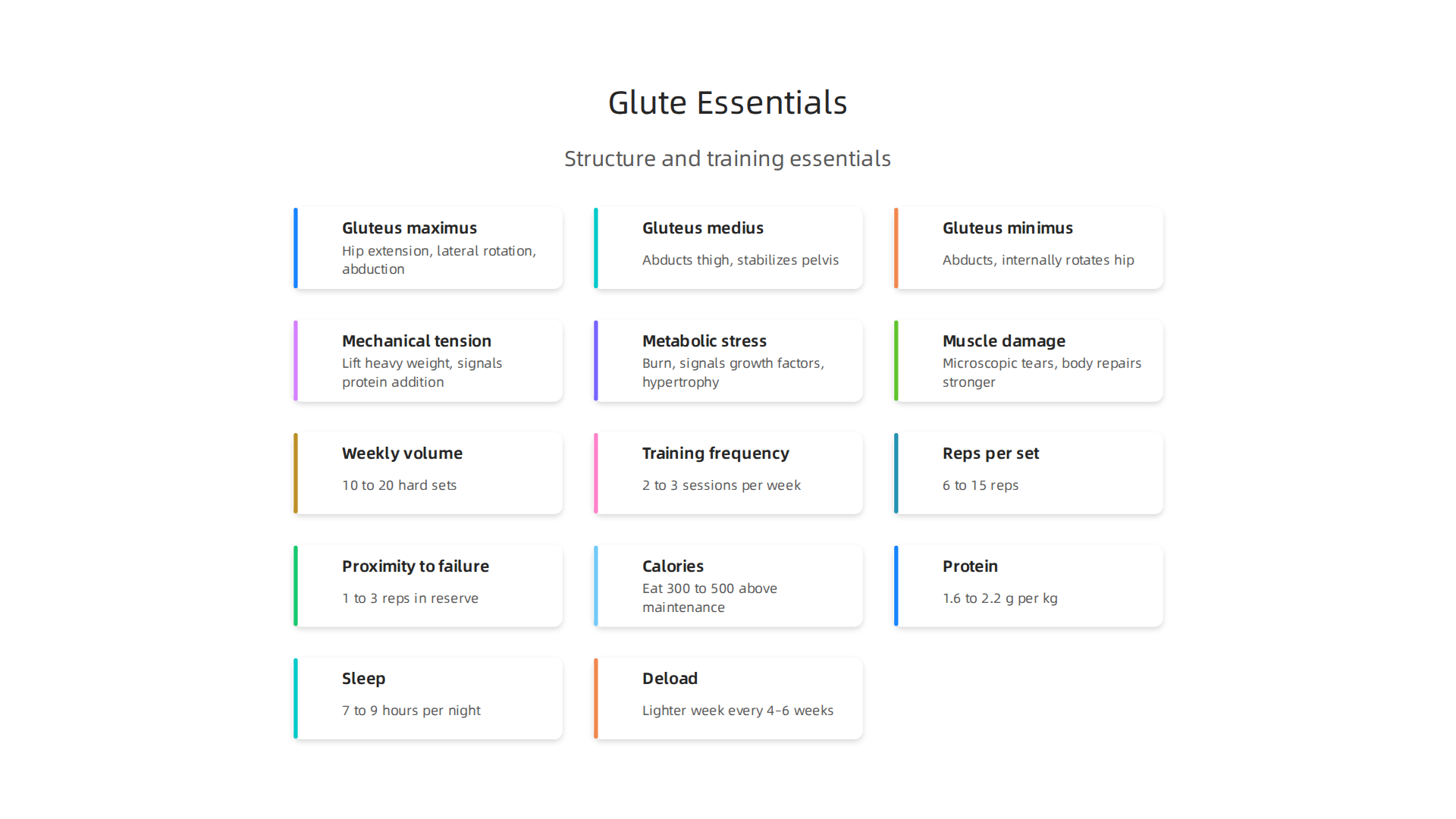
The three gluteal muscles are:
-
Gluteus maximus – the biggest and strongest. It makes up the bulk of your butt. Its main jobs are hip extension (pushing your leg backward) and lateral rotation (turning your thigh outward). It also helps with abduction (moving your leg away from your body). According to the gluteus maximus anatomy overview, this muscle is the chief antigravity muscle when you sit and a powerful extensor when you stand up from a squat. Want a bigger, rounder shape? You need to hammer this muscle hard.
-
Gluteus medius – sits on the side of your hip, under the maximus. It’s fan-shaped and mainly abducts your thigh. It also stabilizes your pelvis when you stand on one leg. The gluteus medius muscle anatomy explains that its anterior fibers help with internal rotation. If your jeans fit loose around the hip or your side glutes feel flat, your medius likely needs more attention.
-
Gluteus minimus – the smallest and deepest of the three. It works closely with the medius to abduct and internally rotate your hip. Together, they are the most powerful abductors in your body.
Here is why this matters for hypertrophy training glutes. Different exercises recruit each muscle differently. Hip thrusts and deadlifts blast the maximus because they happen in a hip extension range of motion. But side-lying leg raises, banded walks, and single-leg work hit the medius and minimus. If you only do squats and deadlifts, you build the maximus while the rest of your glutes stay underdeveloped. That is why many popular lower body exercises pair big compound lifts with isolation moves for full glute development.
Also, fiber angles matter. The maximus runs at about 45 degrees to the femur. That means exercises like hip thrusts or glute bridges, which allow you to fully extend the hip at the top, are perfect for this angle. Exercises that keep your torso more upright, like squats, also work the maximus but with less peak contraction. The medius and minimus respond best to abduction exercises with a slight internal rotation bias.
So when someone searches for the best butt workout for women or wonders why their glutes aren’t growing, the answer often comes back to muscle selection. You need to hit all three heads with the right angles and loads. That is what this guide will show you step by step. But first, let’s make sure you understand the practical implications of this anatomy on your training.
2. The Physiology of Hypertrophy: How Glutes Respond to Resistance Training
Now that you understand the anatomy, let’s look at what actually makes muscle grow. Bigger glutes don’t happen by accident. They happen when you apply the right training stimuli. And your glutes have specific needs because of their size and strength.
Scientists have identified three main drivers of muscle growth.
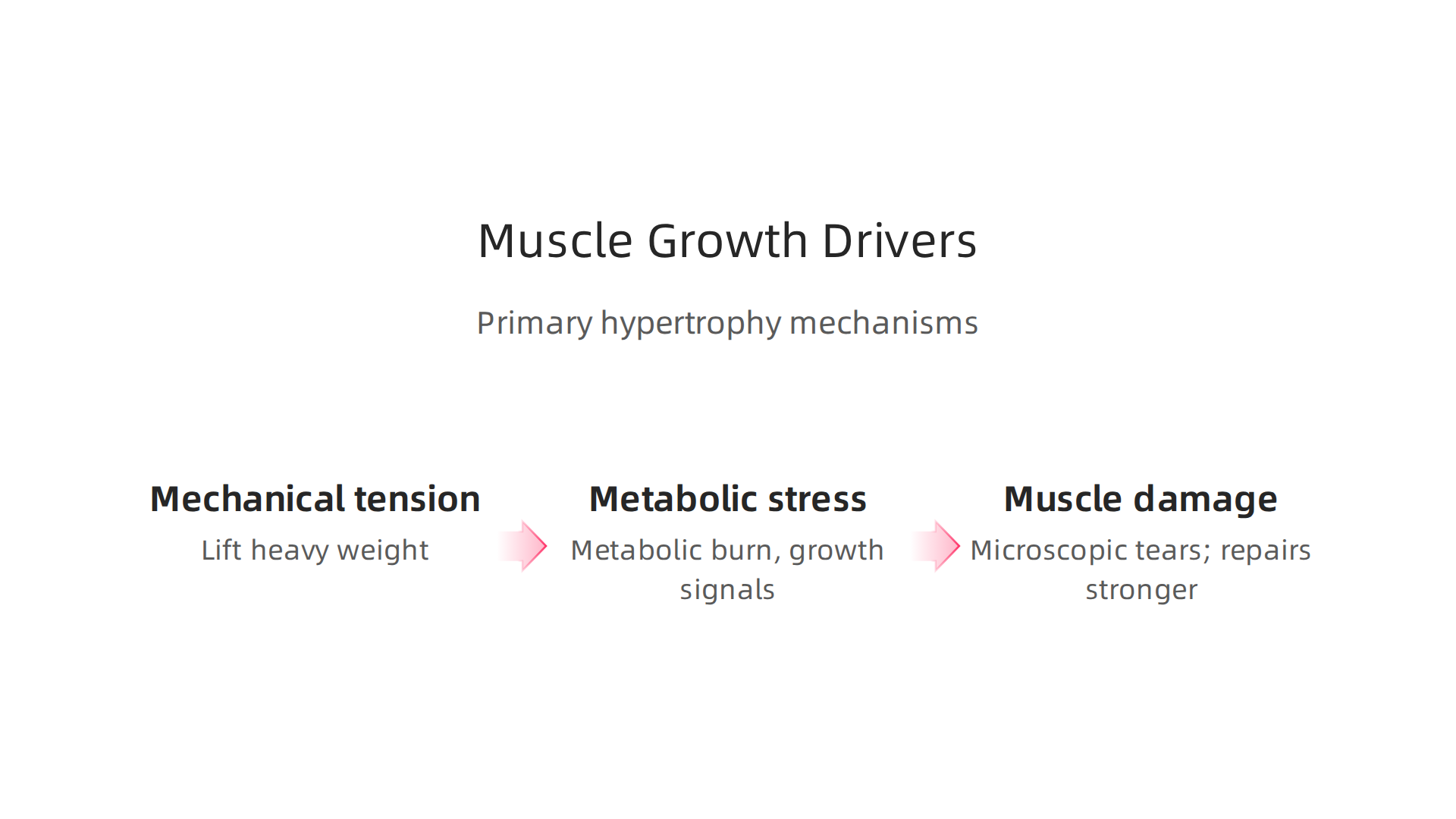
If you want serious results from your hypertrophy training glutes plan, you need to understand all three.
-
Mechanical tension. This is the king of growth. When you lift a heavy weight, your muscle fibers feel tension. That tension signals your body to add more protein to those fibers, making them thicker and stronger. Your glutes, especially the gluteus maximus, are built for this. According to the Gluteus Maximus physiopedia entry, it is the largest and heaviest muscle in your body. That means it can handle a lot of tension. Light weights won’t cut it. You need to challenge it with heavy loads in compound movements. Squats, deadlifts, and hip thrusts are your best friends here.
-
Metabolic stress. This is the burn you feel during high reps or short rest times. When your muscles work without enough oxygen, they build up metabolites like lactate. That burn signals growth factors and can spark hypertrophy. Exercises like high-rep glute bridges, banded hip thrusts, or cable kickbacks create metabolic stress in the glutes. So don’t skip those lighter pump sets. They add a different kind of stimulus.
-
Muscle damage. Microscopic tears in your muscle fibers happen under heavy eccentric loads or new exercises. Your body repairs these tears by making the muscle bigger. Deadlifts, Romanian deadlifts, and heavy hip thrusts cause muscle damage in the glutes. But too much damage without recovery backfires. That is why you need to manage your volume.
Because your glutes are so powerful, they need enough load and volume to grow. You can’t just do a few bodyweight squats and hope for results. Your strength training glutes routine should include heavy compound lifts with progressive overload. Even if you are doing glute exercises at home, you need to add weight through dumbbells, resistance bands, or a barbell. Your lower body exercises should cover hip extension and abduction for full development.
Most research suggests 10 to 20 hard sets per week per muscle group. For the glutes, aim for the higher end because they are large and fatigue-resistant. But here is the kicker: everyone responds differently. Your genetics, training history, and recovery ability all play a role. Some people build glutes easily. Others have to work much harder. That is why you need to track your progress and adjust your plan. If you aren’t seeing growth, you might need more load, more volume, or better recovery. A best butt workout for women still follows these same science-backed rules.
For more on how supplements can support your training, check out this guide on creatine vs pre-workout for strength. It helps you decide what actually works for energy and performance.
Now let’s move into the specific exercises that target each part of your glutes for maximum growth.
3. Top Exercises for Glute Hypertrophy: An Evidence-Based Ranking
You understand the science of muscle growth. Now let’s look at the moves that actually deliver results for your hypertrophy training glutes plan.

Researchers use EMG to measure how hard muscles work during each exercise. These studies give us a clear ranking. Here is what the data says.
Best Exercises for Gluteus Maximus
The hip thrust takes the top spot. One study found it produced the highest glute max activity at 143 percent MVIC according to this review of glute activation exercises. That beats almost every other exercise for targeting the biggest part of your glutes.
Close behind are heavy squats, barbell glute bridges, and step-ups. A data-driven ranking shows the step-up activates gluteus maximus at 100 percent, making it the top glute builder in that study. The hex bar deadlift and Bulgarian split squat also rank very high.
These compound moves create the mechanical tension your glutes need. If you want a best butt workout for women, build your routine around hip thrusts, step-ups, and squats.
Best Exercises for Glute Medius and Minimus
Your glutes have more than just the maximus. The medius and minimus stabilize your hips and give your glutes that full, round shape. Training them makes a difference.
A systematic review found that the hip hitch and pelvic drop exercises generate the highest activity in all segments of both the medius and minimus. Other top choices include the single-leg bridge, side-lying hip abduction with internal rotation, and the resisted side-step.
Adding these to your lower body exercises routine builds balanced glutes. It also helps prevent hip and knee problems down the road.
The Most Important Factor: Progressive Overload
Here is the truth. None of these exercises work if you do not push harder over time. Your muscles adapt fast. If you use the same weight for months, growth stops.
Progressive overload means adding weight, more reps, or extra sets each week. Even small jumps work. Add five pounds to your hip thrust. Do one more rep on your step-ups. Add a set of side-lying hip abduction. These small wins add up.
For glute exercises at home, overload looks different. Use bands with higher tension. Slow down your reps. Shorten your rest time. A solid dumbbells for strength training routine at home helps you keep progressing without a gym.
Your strength training glutes plan should rotate between heavy compound lifts and targeted isolation work. Keep records of your weights and reps. Track what works. Adjust as you go.
Quick Reference: Best Exercises by Goal
| Goal | Top Exercises |
|---|---|
| Gluteus Maximus | Hip thrust, step-up, barbell glute bridge, hex bar deadlift, Bulgarian split squat |
| Glute Medius/Minimus | Hip hitch, single-leg bridge, side-lying hip abduction, resisted side-step |
| At-Home Training | Banded hip thrust, glute bridge, side-lying abduction, curtsy lunge |
Looking for the best gear and supplements to support your training? Check out these fitness offers for everything you need.
Stick with these science-backed moves and add progressive overload every week. Your glutes will grow.
4. Programming Variables for Maximum Glute Growth: Volume, Frequency, and Intensity
Knowing the best exercises is one thing. But how do you put them together to make your glutes actually grow? That is where programming comes in.
Three variables matter most: volume (total sets), frequency (how often), and intensity (how hard). Get these right and your hypertrophy training glutes plan will deliver real results. Get them wrong and you will spin your wheels.
Volume: How Many Sets Per Week
The research is clear on this. More volume drives more growth, but only up to a point. Most studies point to a sweet spot.
A recent meta-analysis found that 10 to 20 hard sets per muscle group per week is the main working range for most people. The analysis showed that 10 or more sets per week produced the best results compared to lower volumes. Beginners can grow with 5 to 10 sets. Advanced lifters may need the higher end.
Here is the catch. Once you get past about 20 to 25 sets per week, growth slows down. You hit what researchers call diminishing returns. You still get some benefit, but not nearly as much per set. For your strength training glutes routine, start at 10 to 12 weekly sets and add 2 to 4 sets only when your performance stays steady.
Frequency: How Often To Train Glutes
You might think hitting glutes once a week with 20 sets is enough. The science says otherwise. Splitting that volume across more sessions works better.
A 2016 meta-analysis by Schoenfeld found that training a muscle more than once per week produces better hypertrophy than one weekly session when volume is matched. The best bang for your buck comes from training glutes 2 to 3 times per week.
Think about it this way. If you do 12 weekly sets for glutes, do 6 sets in two sessions or 4 sets in three sessions. Your body recovers better between workouts and the growth stimulus hits more often. This works great for lower body exercises since your glutes recover fast.
Intensity: How Hard Each Set Should Be
Volume and frequency are useless if you do not push hard enough. Intensity refers to how close you get to failure on each set.
For hypertrophy training glutes, the sweet spot sits in the 6 to 15 rep range. The exact number matters less than your effort level. Take each set to within 1 to 3 reps of failure. That means you stop when you have 1 to 3 more reps left in the tank, not when you physically cannot move the weight.
A good rule of thumb from the research is to keep your RPE around 7 to 9. That is hard but not completely exhausting. Going too far past that into absolute failure adds fatigue without extra growth.
Putting It All Together
Here is how these three variables work in practice.
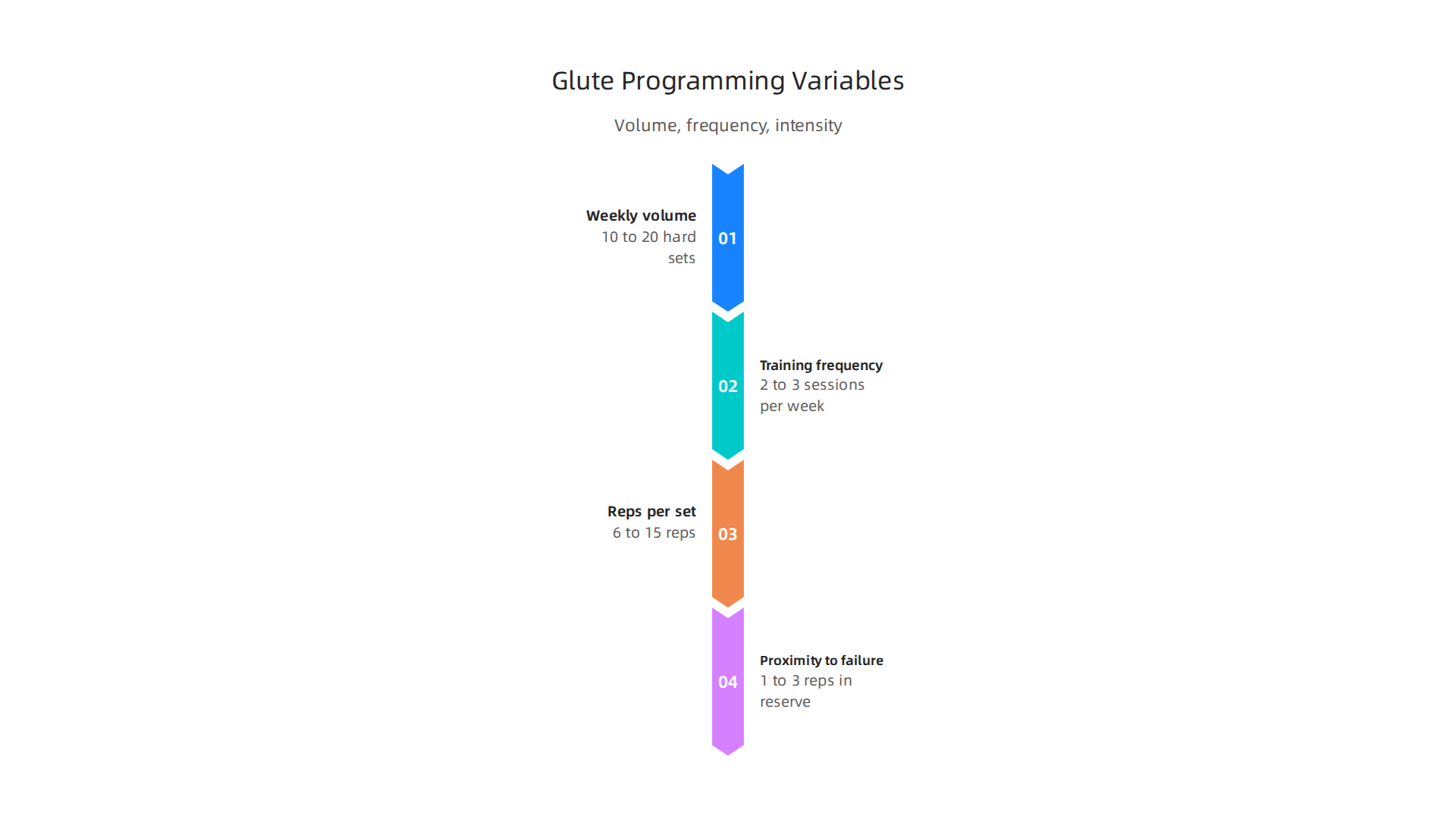
| Variable | Recommended Range |
|---|---|
| Weekly volume | 10 to 20 hard sets |
| Training frequency | 2 to 3 sessions per week |
| Reps per set | 6 to 15 reps |
| Proximity to failure | 1 to 3 reps in reserve (RPE 7-9) |
If you are training at home, these rules still apply. You just adjust the tools. Your glute exercises at home can hit the same volume and intensity using bands, bodyweight, or dumbbells.
And do not forget that recovery matters. Your muscles grow when you rest, not when you train. Good sleep and proper nutrition support everything. A solid magnesium for fitness recovery plan can help with muscle repair and sleep quality.
Start with the numbers above. Track your progress. Adjust only when your performance tells you to. That is how you turn good exercises into real glute growth.
5. Nutrition and Recovery Strategies to Support Glute Hypertrophy
You can train your glutes perfectly. But without the right fuel and rest, those hard sets will not turn into new muscle.

Hypertrophy training glutes works best when you pair your workouts with smart eating and real recovery.
Let us walk through what actually matters.
Eat Enough to Grow
Your body needs extra energy to build muscle. If you eat at maintenance calories, you might still grow slowly. But for real glute gains, a modest caloric surplus of 300 to 500 extra calories per day makes a big difference. Research shows that a higher energy intake helps your body use protein more effectively for muscle building. The analysis on energy surplus and muscle protein accretion found that eating more calories allowed healthy men to store more protein when combined with resistance training.
Do not go overboard. An extra 300 to 500 calories is enough. That might be a banana with peanut butter and a glass of milk. Simple.
Protein: The Building Block for Glutes
Protein is non-negotiable for hypertrophy training glutes. The science consistently shows that aiming for 1.6 to 2.2 grams per kilogram of body weight per day maximizes muscle growth. For a 150-pound person (68 kg), that is about 109 to 150 grams of protein daily.
Why this range? Studies on the science of protein and muscle growth confirm that intakes above 1.6 g/kg per day are strongly linked to better hypertrophy. The key is spreading your protein across the day, about 20 to 40 grams per meal, and including leucine-rich sources like chicken, eggs, dairy, soy, and whey.
If hitting those numbers feels tough, a good protein powder can help. You can find high quality protein supplements that make it easy to reach your daily target without cooking extra meals.
The Recovery Factor: Sleep, Stress, and Deloads
Here is where most people fall short. They train hard, eat well, but ignore recovery. Your glutes grow when you rest, not when you lift.
Sleep. Aim for 7 to 9 hours per night. Poor sleep lowers growth hormone and slows muscle repair.
Stress. High stress raises cortisol, a hormone that breaks down muscle. Manage it with walks, deep breathing, or light stretching.
Deload weeks. Every 4 to 6 weeks, drop your training volume or intensity by about 50 percent for one week. This lets your nervous system and muscles fully recover. Many serious lifters include a deload and see better long-term gains.
For extra recovery support, some athletes turn to targeted supplements. If you struggle with soreness, learn how bromelain for muscle recovery can help reduce inflammation naturally.
The Simple Plan
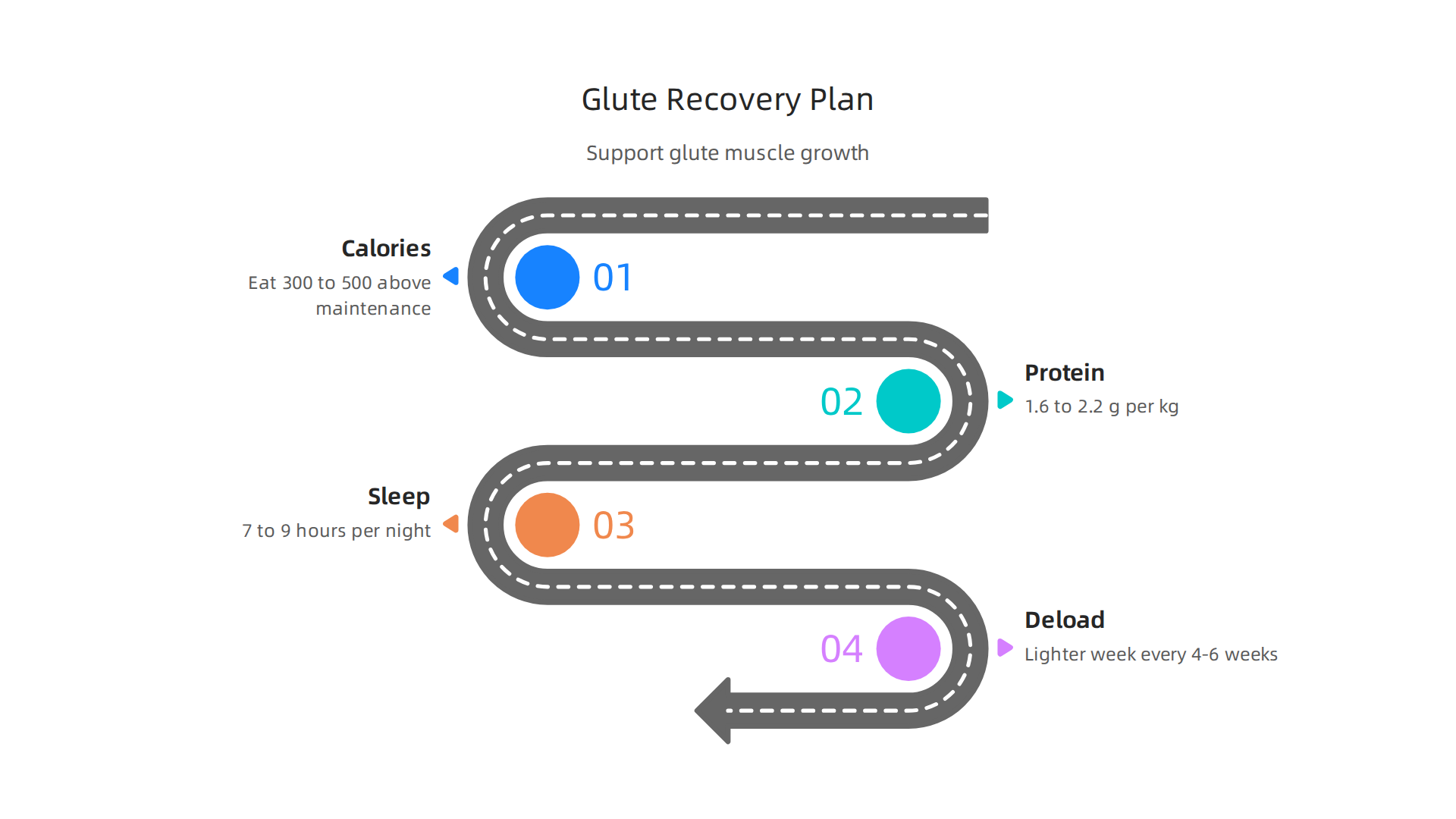
| Factor | What to Do |
|---|---|
| Calories | Eat 300 to 500 above maintenance |
| Protein | 1.6 to 2.2 g per kg body weight daily |
| Sleep | 7 to 9 hours per night |
| Deload | One lighter week every 4 to 6 weeks |
Nail these and your strength training glutes progress will accelerate. Your workouts create the stimulus. Your nutrition and recovery turn that stimulus into real, visible growth.
6. Common Mistakes and How to Avoid Them in Glute Hypertrophy Training
Even when you plan everything right, small errors can steal your gains. Let’s look at the three most common mistakes in hypertrophy training glutes and how to fix them.
Mistake 1: Only Doing Squats and Skipping Direct Glute Work
Squats are great for lower body strength. But they don’t fully activate your glute max. If you rely only on squats, your glutes stay underdeveloped. You need exercises that directly target the glutes.
The fix: Add movements like hip thrusts, step-ups, and deadlifts. A recent study found that the step-up produces the highest gluteus maximus activation among common exercises. You can see the full list in this EMG analysis of gluteus maximus exercises. Pair compound lifts with isolation work like glute bridges and banded hip thrusts.
Mistake 2: Poor Mind-Muscle Connection and Bad Form
If you feel your lower back or quads working harder than your glutes, your form is off. This shifts the load away from the target muscle. Many people rush through reps without squeezing the glutes.
The fix: Slow down. Focus on contracting your glutes at the top of each rep. Stop your hip thrust when your body forms a straight line from knees to shoulders. And keep your feet flat on the floor during bridges. These small form fixes make a big difference in results.
Mistake 3: Overtraining Without Enough Rest
Training your glutes hard every day sounds like a good idea, but it backfires. Your muscles need time to repair. Without proper recovery, you hit a plateau and raise your injury risk.
The fix: Schedule at least one full rest day between heavy glute sessions. Listen to your body. If you feel extra sore or tired, take an extra rest day or do a light activity like walking. For extra recovery support, check out magnesium benefits for fitness to help your muscles relax and rebuild faster.
Quick Fix Summary
| Mistake | The Fix |
|---|---|
| Only squats | Add hip thrusts, step-ups, direct glute work |
| Poor form | Slow reps, squeeze glutes, check alignment |
| No recovery | Rest days, sleep well, use recovery aids |
Avoid these pitfalls and your strength training glutes progress will stay on track. Every rep and every rest day counts.
7. Sample Glute Hypertrophy Routine: Putting Evidence Into Practice
Now you know what mistakes can slow your progress. It is time to put that knowledge into action with a complete weekly plan built on research.
This 3-day routine uses the latest evidence on training volume, exercise variety, and recovery. Research shows that 10 to 20 hard sets per muscle group per week produces the best results for most people. Training each muscle group at least twice per week also beats training it once. This plan follows both rules.
Weekly Schedule
Day 1 Strength Focus
Warm up with bodyweight glute bridges. Then do 4 sets of 6 to 8 barbell hip thrusts. Follow with 3 sets of 8 to 10 Bulgarian split squats per leg. Finish with 3 sets of 12 to 15 cable kickbacks and 3 sets of 15 banded side steps per direction.
Day 2 Hypertrophy Focus
Start with 4 sets of 8 to 10 barbell squats. Move to 3 sets of 10 to 12 Romanian deadlifts. Add 3 sets of 10 to 12 step-ups per leg. End with 3 sets of 15 side-lying hip raises on each side for glute medius.
Day 3 Volume and Pump Focus
Begin with 3 sets of 5 deadlifts. Then do 3 sets of 15 to 20 hip thrusts. Add 3 sets of 12 to 15 reverse hypers. Finish with 3 sets of 15 fire hydrants per leg.
This mix covers all glute functions. Horizontal moves like hip thrusts target glute max. Vertical moves like squats and deadlifts build overall lower body strength. Lateral moves like banded side steps strengthen glute medius.
Set and Rep Guidelines
This plan delivers about 12 to 15 sets of direct glute work each week. Rest 2 to 3 minutes between compound lifts and 60 to 90 seconds for isolation exercises.
Beginners can start with fewer sets. Advanced lifters may need closer to 20 weekly sets. If your performance drops, cut back.
Progressive Overload and Deload Weeks
Add weight or reps each week when your form stays clean. If you finish 4 sets of 8 hip thrusts easily, try 4 sets of 9 or add 5 pounds next time. If progress stalls for 2 weeks, take a deload week. Cut your sets in half or drop weight by 30 percent for one week. This helps your muscles fully recover so you come back stronger.
Auto-Regulation Adjustments
Some days you feel tired. That is normal. On those days, drop one set from each exercise or reduce weight by 10 to 15 percent. The goal is long-term consistency, not one perfect workout.
If you train at home, you need a barbell, a bench, and a set of reliable dumbbells. Check out these recommendations for dumbbells for strength training to build real strength and fix imbalances.
For extra gear and tools to keep your routine on track, explore fitness offers and equipment deals that support consistency and progress.
Why This Plan Works
A detailed analysis found that 10 or more sets per muscle group per week produces the best results for hypertrophy. Training each muscle at least twice per week also outperforms once per week sessions. This routine satisfies both conditions. Read the full breakdown of sets per week for muscle growth research to understand the science deeper.
Stick with this plan for 8 to 12 weeks. Track your lifts. Eat enough protein. Sleep well. Your hypertrophy training glutes progress will follow.
Summary
This article is a practical, science-backed guide to building bigger, stronger glutes. It explains glute anatomy (maximus, medius, minimus) and why you must target each head, then walks through the three drivers of muscle growth—mechanical tension, metabolic stress, and muscle damage—and how to apply them to glute training. You get an evidence-based ranking of the best exercises (hip thrusts, step-ups, deadlifts, band work), clear programming rules (10–20 hard sets/week, train glutes 2–3× weekly, 6–15 rep ranges, RPE 7–9), and a full 3-day sample routine. The guide also covers nutrition (300–500 kcal surplus, 1.6–2.2 g/kg protein), recovery strategies (sleep, deloads, stress management), common mistakes to avoid, and practical ways to progress at home or in the gym. After reading, you’ll know which movements to prioritize, how to structure weekly volume and intensity, and what to change when your progress stalls.





Get practical training, recovery, and nutrition insights in your inbox