
Strength Training for Runners The Missing Piece to Faster Race Times and Fewer Injuries


Introduction: Why Every Runner Must Lift
If you run regularly, you might think your legs are strong enough. It makes sense. You pound the pavement for hours each week. You build endurance. You build mental toughness. But here is the truth that many runners miss. Running alone does not build all the strength you actually need.

Running is a repetitive motion that works your body mostly in a straight line. It strengthens your calves and quads, but it often leaves your glutes, hamstrings, and deep core muscles weak or unbalanced. This imbalance is a direct path to common runner injuries like runner’s knee, shin splints, and IT band syndrome.
Here is the evidence that changes everything. Research shows that adding strength work to your weekly routine can cut your injury risk by 50 percent. That is huge. The same studies show it can boost your running economy by up to 8 percent. That means you use less energy to hold the same pace. You get faster and last longer without any extra running.
This guide is different from the usual advice. We focus on evidence-based methods that fit into a real schedule. We cover exactly how to combine these activities so you feel stronger and run better. If you want to build a solid foundation, it helps to start with basic tools like strength training with dumbbells. And do not underestimate the power of a stable midsection. Working on building a strong core will help you keep good form even when your legs get tired at mile 18.
Forget the old fear that lifting will make you bulky and slow. The truth is the opposite. Strength training running is the missing piece for most athletes. It builds power in your stride. It builds stamina in your muscles so they do not give out late in a long run. This is the secret to improving your stamina training while protecting your body.
In the sections ahead, you will learn exactly how to schedule your week, which exercises matter most, and how to lift without getting bulky. No fluff. Just practical, science-backed advice that works. Let’s get started.
Why Strength Training Is Non‑Negotiable for Runners
If you still think strength training is optional for runners, let me show you why that idea is outdated. It is not optional. It is the single most effective way to protect your body and unlock faster times without adding more miles. Every serious strength training runner program exists for this exact reason. Your body needs the balance.
Let’s start with injury prevention. Every run pounds your joints. Weak glutes or an unstable core force your knees and shins to absorb that impact instead of your muscles. Over time, this leads to runner’s knee or shin splints. A systematic review found that strength training can reduce overuse injury risk by up to 50 percent. That alone should convince you. Single-leg exercises like lunges and step-ups build the specific stability your knees need. This is exactly what we cover in our guide on how to use dumbbells for strength training to fix common running imbalances.
Next is running economy. This is a fancy term for how efficiently your body uses oxygen. Better economy means you run faster at the same effort without getting as tired. Strength training improves the connection between your brain and your muscles. Your muscles learn to fire faster and with more power. Studies consistently show that runners who lift improve their running economy and can run longer before they hit the wall. This is the secret to smart stamina training that actually works.
Finally, you need to protect your hard-earned muscle. When you run high mileage without lifting, your body sees muscle as extra weight and starts to break it down for energy. This hurts your power and your endurance. A short, focused strength session tells your body to keep that muscle. It also reinforces a stable midsection. A stable core keeps your pelvis level when your form starts to slip at mile 20. Working on building a strong core is a direct investment in your marathon finish time.
These three reasons alone make it clear. Strength training is not a break from your real training. It is the foundation that lets you train harder and race faster without getting hurt.
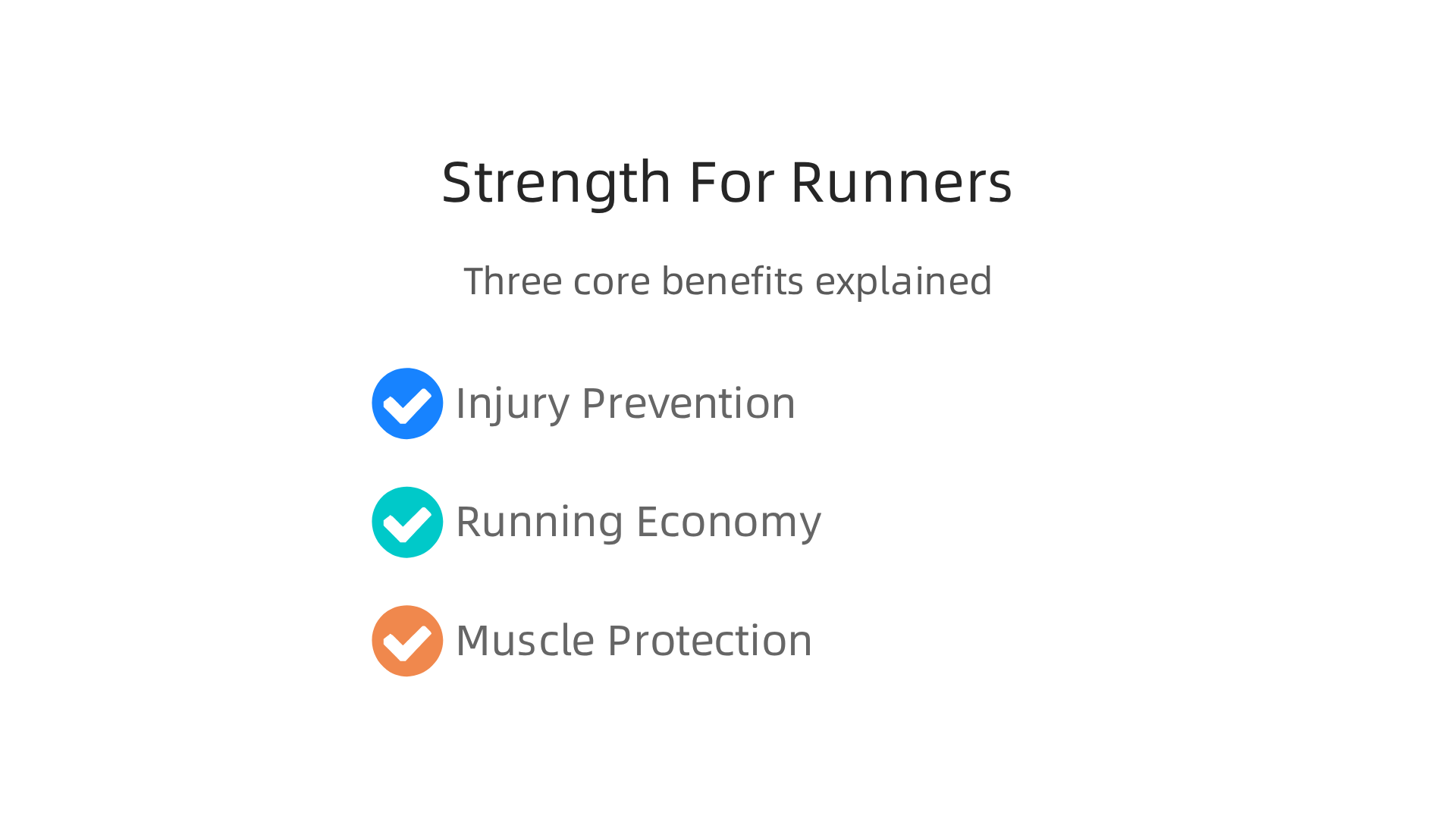
The Top Science-Backed Strength Exercises for Runners
So you know you need to lift. Now, what should you actually do? Let’s break down the three types of exercises that give you the biggest return on your time.
Compound lifts are your foundation. These are big moves like squats and lunges. They build raw power because they work multiple muscles at once. This is why they are the core of any good strength training runner plan. If you only have 20 minutes, spend it here. You will hit your glutes, quads, hamstrings, and core in one go. The team at Gymshark points out that exercises like squats and deadlifts directly help improve your stride length and reduce injury.

Want to fuel these heavy sessions? Understanding the difference between strength and energy supplements can help. Check out our comparison of creatine vs. pre-workout to see what fits your goals.
Plyometrics add the explosion you need. These are jump exercises. Box jumps, bounds, and jump squats teach your muscles to fire quickly. Runners World recommends starting with simple jump lunges or low box jumps if you are new. This power translates directly to your run. You will feel lighter on your feet and cover more ground with each push-off. It is a secret weapon for stamina training that actually works.
Core and stability drills lock everything in place. A strong core keeps your pelvis steady. When your form starts to slip at mile 18, your torso holds you together. Planks and single-leg bridges are perfect for this. They fix the little muscle imbalances that cause big problems like runner’s knee. E3 Rehab highlights these exercises as some of the best for runners because they protect your joints and improve your form.
Stick to these three categories and you will cover all your bases. Your body will get stronger, faster, and more durable.

Because these moves are intense, your muscles need real support to recover. Magnesium is a key player here. Our article on magnesium benefits for fitness explains how it helps your muscles relax after hard strength sessions.
Compound Lifts: Squats, Deadlifts, and Lunges
You have heard these names before. But do you know why they matter so much for your running? Here is the simple truth. These three exercises give you the biggest return for your effort. They are the core of any smart strength training runner plan.
Barbell back squat. This move targets your quadriceps, glutes, and hamstrings. It builds the power you need to drive forward on every stride. Experts at E3 Rehab explain that squats are one of the best exercises for runners because they strengthen the exact muscles you depend on most.
Deadlift variations. The conventional deadlift and the Romanian deadlift are your secret weapons. They build a strong posterior chain. That is your back, glutes, and hamstrings working together. When this chain is strong, you run taller and your form holds up longer. It is a key part of strength training running that many people skip.
Walking lunges. Running happens one leg at a time. Walking lunges fix that. They improve your unilateral stability and hip mobility. They also help correct muscle imbalances. A strong lunge means a stronger, safer run.
The team at Gymshark confirms these lifts help improve your stride and reduce injury. They are essential for stamina training that actually works.
To perform these lifts with perfect form, start with the right tools. Our guide on dumbbells for strength training shows you how to build strength and fix imbalances safely.
And once you are ready to commit to these moves, you need solid equipment. Explore trusted barbells and gear to set up your home gym. It is an investment in your long-term health and speed.
Plyometrics for Power and Speed
You have built a solid foundation with squats, deadlifts, and lunges. Now it is time to add explosive power. That is where plyometrics come in. These jumping exercises train your muscles to produce maximum force in a short time. For any strength training runner, that translates to faster, more efficient strides.
The three most effective plyometric moves for runners are box jumps, pogo jumps, and broad jumps. Box jumps improve your reactive strength and hip power. Pogo jumps train your calves and Achilles tendon to store and release energy like a spring. Broad jumps build horizontal power that carries over directly to your running stride. Experts at E3 Rehab confirm that running-specific plyometrics mimic the short ground contact time of actual running.
The best part? The results are real. Research shows that adding just two plyometric sessions per week can improve your 5k and 10k race times by 2 to 5 percent. Gymshark notes that explosive plyometric exercises help improve your stride and reduce injury risk. A strong, springy stride means better stamina training and less wasted energy.
Start with low box jumps and two-footed pogo hops. Focus on landing softly and quickly. As you progress, add broad jumps and single-leg variations. You do not need a lot of equipment. A sturdy box and your own bodyweight are enough.
Plyometrics are high impact, so recovery matters. Check out our guide on bromelain for muscle recovery to help your legs bounce back faster. When you combine compound lifts with plyometrics, you build a complete strength training runner program that makes you faster and more resilient.
Core Stability and Injury Prevention
All that explosive power from plyometrics needs a stable foundation. Without a strong core, your body cannot control the forces you create. That is where many runners get stuck.
Here is what happens when your core is weak. During each stride, your pelvis drops to one side and your trunk rotates too much. This wastes energy and puts extra stress on your hips, knees, and shins. Over time, these movement flaws can lead to shin splints and runner’s knee.
The fix is simple. You need core exercises that teach your body to stay still and stable while your legs move. The best moves for runners are planks, bird-dogs, and dead bugs. These exercises train your deep core muscles to resist rotation and keep your pelvis level.
Research backs this up. A 2025 systematic review found that exercise-based programs can reduce injury rates by at least 20 percent. Track and Field News reported that multiple studies show strength training lowers injury risk for runners. And Marathon Handbook noted that strength training reduces sports injuries to less than one-third of the normal rate.
When you combine core stability with the compound lifts and plyometrics from earlier sections, you build a complete strength training runner program. Your body learns to produce force and also to control it.
Want a full routine? Check out our science-backed ab workout routine for a stronger core. It includes planks, bird-dogs, and dead bugs with proper form tips.
How to Structure Your Strength Training Routine
So you know the exercises from the previous section. Now you need a plan to fit them into your week.

This is how you structure your strength training runner routine for the best results.
First, aim for 2 to 3 strength sessions per week. That is the sweet spot for most runners. Recover Athletics recommends exactly this range to build strength without burning out your legs. Doing more than three sessions can cut into your running recovery. Doing less than two may not give you the gains you want.
Next, timing matters. The best approach is to put strength training after easy runs or on separate days from hard workouts. Runner’s World suggests doing strength on the same day as a run, but after the run and not right before a hard session. This keeps your legs fresh for speed work and long runs. If you do strength after a hard workout, you risk poor form and slower recovery.
Finally, use periodization. Do not do the same routine all year. Periodization means changing your strength work based on your training phase. In the off-season or base-building phase, you can lift heavier weights with fewer reps. As you get closer to race season, shift to lighter loads and more explosive movements like plyometrics. A scientific guide for endurance athletes notes that at least two sessions per week are needed for meaningful progress, and adjusting the load over time prevents plateaus.
For equipment to support your strength training runner plan, consider adding dumbbells to your setup. Check out our guide on dumbbells for strength training to pick the right weights for your goals.
When you pair good frequency, smart timing, and periodized programming, your stamina training and running performance both improve. Your body adapts, your injury risk drops, and you stay on track all year.
Frequency and Timing Around Runs
Now let’s talk about when exactly to do your strength work. Getting the frequency and timing right makes a huge difference in how your body responds.
Most people wonder how many sessions they really need. The sweet spot for a strength training runner is 2 to 3 sessions per week. Research from Recover Athletics confirms that two sessions per week improve running economy with surprisingly little extra fatigue. You get the benefits without feeling wiped out for your next run.
What about when to do these sessions? Here is the simple rule. Put your strength training right after an easy run or on a separate easy day. A guide from Runner’s World explains that doing strength on the same day as a run works well, as long as you run first. This approach reduces interference between the two types of training.
Here is another key timing tip. Keep hard strength sessions at least 24 to 48 hours before your quality runs. That means no heavy leg work the night before a track workout or long run. Your legs need that buffer to recover fully. A scientific guide for endurance athletes stresses that at least two sessions per week are required for real progress, and spacing them properly keeps your quality runs sharp.
For extra support during your recovery days, some athletes find that a shilajit supplement helps the body bounce back faster between sessions. You can read more about that in our guide on shilajit supplements for athletes.
When you pair the right frequency with smart timing, your strength training running plan works with your running schedule, not against it. Your stamina training stays on track, your legs feel fresh, and you get stronger without burning out.
Periodization for Long‑Term Gains
Have you ever wondered why some runners lift hard all year but never seem to get faster? The trick is periodization. That means changing your strength training runner plan across the year based on your racing season.
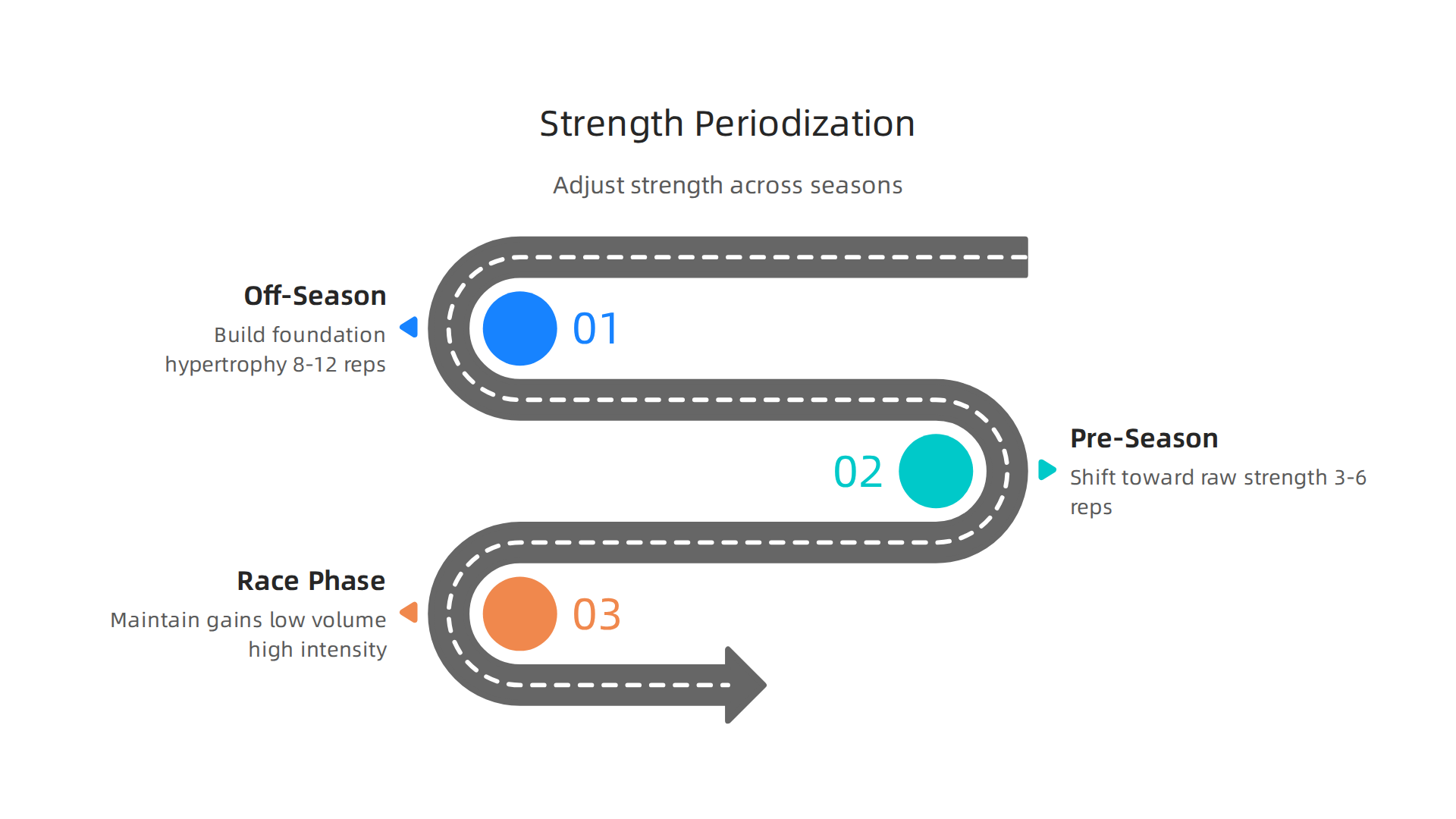
Instead of doing the same thing every week, you shift your focus as your goals change.
During the off-season, you want to build a solid foundation. Focus on hypertrophy work, which means 3 to 4 sets of 8 to 12 reps per exercise. This phase builds muscle size and prepares your joints for heavier work ahead. Research from RunDNA explains that traditional high-rep sets of 12 to 15 offer little extra benefit for runners beyond what you already get from running. So use this phase to actually grow some quality muscle.
Then comes the pre-season phase. This is when you shift toward raw strength. Drop the reps and increase the weight. Aim for 3 to 5 sets of 3 to 6 reps per exercise. Heavier loads improve your running economy and strengthen your bones. A guide from Gymshark recommends prioritizing proper form and unilateral movements like single‑leg exercises during this stage to fix imbalances.
Finally, during your race phase, you maintain without burning out. Keep the volume low but the intensity high. One or two heavy sets at high load per session is enough to preserve your hard‑earned gains. Your strength training with running stays effective without draining your legs for race day.
For equipment that makes adjusting loads through these phases easier, check out our guide on dumbbells for strength training. Having the right weights at hand makes periodization so much simpler.
Structuring your strength training running around these phases lets you build real strength when it matters most and stay fresh when race day arrives. Think of it as smart stamina training for the long haul.
Evidence-Based Recovery Strategies for Strength and Running
You have your periodization plan dialed in. Now comes the part that many runners skip: recovery. Without it, your body never fully adapts to the work you put in. Research shows that recovery is just as important as the sessions themselves. Here are three evidence-backed strategies to maximize your results from strength training runner work.
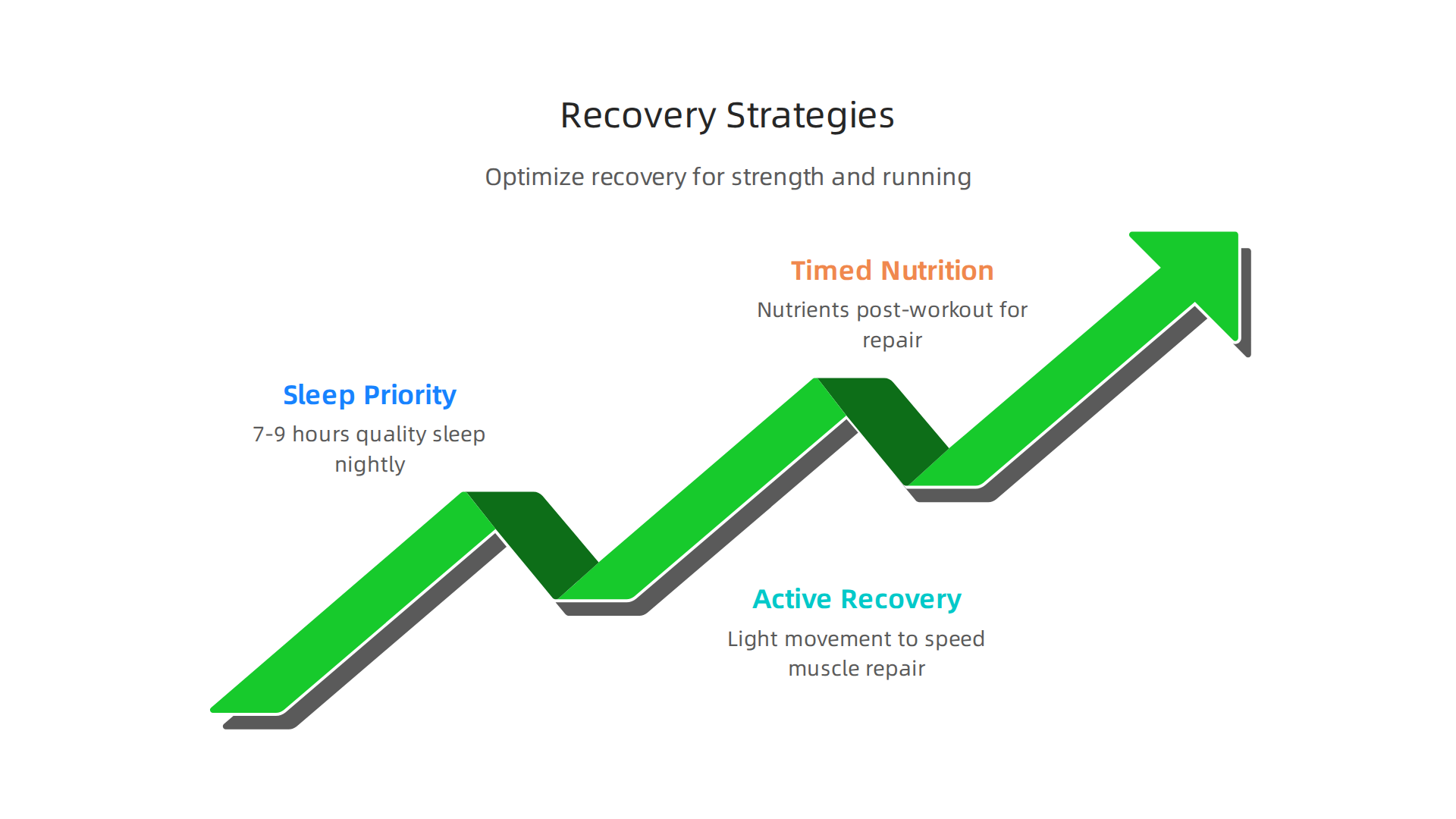
1. Sleep is your number one recovery tool. While you sleep, your body repairs muscle tissue, balances hormones, and solidifies the gains from your strength training running sessions. Shoot for 7 to 9 hours of quality sleep each night. If you struggle with winding down, natural sleep aids like magnesium supplements can help relax muscles and improve sleep quality. That directly supports your stamina training and overall progress.
2. Active recovery speeds up muscle repair. On your rest days, a light jog, a gentle stretch, or a short walk increases blood flow to sore muscles. This helps flush out waste products and delivers oxygen and nutrients that speed healing. Many runners also use mobility work during active recovery to keep joints healthy. For a natural recovery boost, some athletes add bromelain for muscle recovery, an anti-inflammatory enzyme that can reduce soreness and help you get back to your strength training running routine faster.
3. Time your nutrition wisely. Your muscles are most receptive to nutrients within the two-hour window after a tough workout. Consume 20 to 40 grams of protein along with some carbohydrates during this period. This supports muscle repair and refills your energy stores. For an added edge, consider creatine supplementation. Research suggests creatine, when combined with your strength training with running, can improve recovery and next-day performance.
By making these recovery habits a priority, you will get stronger, run faster, and stay injury-free for the long haul. Recovery is not a break. It is a vital piece of the puzzle.
Debunking Common Myths About Strength Training and Running
If you have ever skipped the weight room because you were afraid of getting bulky or hurting yourself, you are not alone. A lot of runners hold onto outdated ideas about strength training runner work. These myths can hold you back from getting faster, stronger, and more resilient. Let us set the record straight.
Myth: Lifting weights will make you bulky and slow you down.
This is probably the most common fear. But here is the reality: adding muscle through smart strength training running actually improves your body composition and boosts your power-to-weight ratio. You will not accidentally turn into a bodybuilder overnight. That takes years of focused calorie surplus and specific training. For runners, lifting helps you maintain lean muscle while burning fat, which makes you lighter and more explosive on the road. As Runners World explains, lifting weights can make you faster, not slower.
Myth: Strength training increases your risk of injury.
Some runners worry that lifting heavy will strain joints or pull muscles. The opposite is true when you use proper form. Strength training with running builds stronger bones, tendons, and ligaments. It also corrects muscle imbalances that often lead to overuse injuries. The Polar blog points out that the main goal of strength training for runners is to prevent injury. With good technique and gradual progression, lifting is one of the best things you can do for long term health.
Myth: Runners only need bodyweight exercises like push ups and lunges.
Bodyweight work is a great start, but it is not enough to keep your bones dense and your muscles strong as you age. Heavier loads stimulate bone remodeling and increase mineral density, which is crucial for runners who face constant impact. Adding exercises like squats, deadlifts, and presses with external weight challenges your body in ways bodyweight alone cannot. If you want to build real resilience, consider investing in quality equipment like dumbbells for strength training to take your stamina training to the next level.
Do not let old myths keep you from becoming a stronger, more durable runner. Science shows that strength training runner work is safe, effective, and essential.

Start light, focus on form, and watch your runs improve.
Nutrition and Supplements to Support Strength and Running
Now that you know lifting will not hurt your running, let us talk about what to put inside your body. The right food and a few smart supplements can make your strength training runner work pay off much faster.
Protein is your first priority. Aim for 1.6 to 2.2 grams of protein per kilogram of body weight each day. That roughly means 110 to 150 grams for a 150 pound person. Spread it across your meals to keep your muscles in repair mode. Good sources are chicken, eggs, Greek yogurt, tofu, and quality protein powders. Without enough protein, your strength training running efforts cannot build the muscle you are working for.
Creatine monohydrate is your secret weapon. This is one of the most researched supplements in the world. The International Society of Sports Nutrition calls it the most effective supplement for high intensity exercise performance. Recent research confirms that combining creatine with resistance training leads to greater gains in lean muscle. And here is the part runners love: it boosts power without making you bulky. Healthline notes it can enhance high intensity performance by up to 15 percent. That means stronger hill sprints and faster finish kicks. A 2026 meta-analysis also found that creatine’s muscle building effect works best when paired with resistance training, which is exactly what you are doing with your stamina training plan.
Beta-alanine helps you go harder for longer. It buffers the acid buildup in your muscles during high intensity intervals. That burning feeling in your legs during a tough track session? Beta-alanine pushes that feeling back. It is safe, well studied, and works especially well for runners doing speed work or interval training.
If you want an easy way to get started with quality supplements, check out trusted supplement retailers for pure creatine monohydrate and beta-alanine. You can also learn more about choosing between creatine and pre-workout depending on your goals. The science is clear: smart nutrition takes your strength training running to the next level without adding bulk or slowing you down.
Sample Weekly Training Plan for Runners (With Strength Integration)
Great nutrition sets you up for success, but you still need a clear plan to put it all together. Let me show you exactly how a strength training runner can schedule running and lifting without burning out.
The secret is pairing your hard days with hard days and your easy days with easy days. That way your body gets real recovery when it needs it. Most runners do best with two strength sessions per week, and this plan builds them right into your running rhythm.
Monday: Easy run + full body strength
Start your week with a 30 to 45 minute easy run at a conversational pace. Keep it relaxed. Then hit a full body strength session using the Gold’s Gym 2026 recommended structure of compound lifts like squats, push ups, and rows. This combination warms up your muscles before you load them, and you get the calorie burn and hormonal benefits of strength work on the same day as your run.
Wednesday: Intervals + lower body plyometrics
Wednesday is for speed and power. Run 5 to 8 x 400 meters at mile race pace with equal recovery jogs. Then do 15 minutes of lower body plyometrics like box jumps, squat jumps, and lateral bounds. This fast twitch muscle work directly boosts your running economy and helps you close races stronger.
Friday: Long run + core/stability work
Your long run builds endurance. Keep it steady at 60 to 90 minutes, depending on your goal. Afterward, spend 10 to 15 minutes on core and stability exercises like planks, dead bugs, and single leg stands. A strong core keeps your form solid when fatigue sets in. If you want more core exercises, check out the science backed ab workout routine for a stronger core.
Remember to take rest days between hard sessions. Your body needs time to rebuild. Consistency beats intensity every time for the strength training runner. Stick with this weekly rhythm for a month, and you will feel the difference in your running and your lifts.
For quality dumbbells, resistance bands, or recovery tools that make these sessions easier, check out trusted training gear designed for everyday athletes.
Summary
This article explains why strength training is essential for runners, summarizing the science and practical steps to get stronger, faster, and less injury-prone. It covers the three high‑return exercise categories—compound lifts (squats, deadlifts, lunges), plyometrics for power, and core/stability work—and explains how each specifically improves running economy and reduces common overuse injuries. You’ll learn evidence-based frequency and timing (typically 2–3 sessions weekly, placed after easy runs or on separate days), how to periodize through off‑season, pre‑season, and race phases, and how to pair lifting with recovery strategies like sleep, active recovery, and targeted nutrition. The guide also addresses supplement choices that meaningfully support strength training and recovery, debunks common myths (like getting bulky), and includes a sample weekly plan you can follow. After reading, you’ll know which exercises to prioritize, how to fit strength work into your running schedule, and how to recover so you actually gain resilience and speed without sacrificing race fitness.






Get practical training, recovery, and nutrition insights in your inbox