
Vitamin Q10 Supplements for Energy and Recovery What Science Shows

Why This Guide Exists
Are you tired of guessing which supplements actually work? You walk down the aisle and see multivitamin supplements, vitamin b12 supplements, vitamin c supplement, and magnesium supplements. It is a lot to sort through.

The marketing claims all sound the same, and it is hard to know what is worth your money.
We get it. That is exactly why we wrote this guide.
We focus on one ingredient that stands out for energy and recovery: vitamin q10 supplements. Also known as Coenzyme Q10 or CoQ10, this natural compound helps your cells turn food into fuel. It also protects your cells from damage. As we age or train hard, our natural CoQ10 levels drop. That is where supplementation helps.
Recent science backs this up. A large analysis of 24 studies found that vitamin q10 supplements effectively increase CoQ10 levels in your blood (source). Another study showed real benefits for people doing high-intensity interval training, helping with physical function and recovery (source). Researchers have also found that vitamin q10 supplements can reduce oxidative stress and prevent muscle damage after exercise (source). An up-to-date overview of CoQ10 and sport performance confirms its growing role for everyday athletes like you (source).
We cut through the hype. We bring you clear, evidence-based answers.
If you are ready to try vitamin q10 supplements, quality matters. You want a product that is pure and effective. Check out our recommended CoQ10 supplements to find a trusted option that supports your energy and recovery.
Let us help you take the guesswork out of your supplement routine.
What Is CoQ10 and Why Should Fitness Enthusiasts Care?
Have you ever hit that mid-afternoon wall or felt your legs turn to lead halfway through a workout? That feeling of running on empty has a real biological reason.

And it is tied directly to a tiny molecule inside every cell in your body.
Coenzyme Q10, or CoQ10, is a natural compound your body makes. Think of it as your cellular battery charger. It lives inside the mitochondria, the parts of your cells that turn food into usable energy. Without enough CoQ10, your cells simply cannot produce energy as efficiently. Your muscles, heart, and brain all depend on it.
Here is the tricky part. Your natural CoQ10 levels start dropping as you age. By the time you hit your 30s and 40s, your body makes less than it used to. And here is what many fitness enthusiasts do not realize: intense exercise also depletes CoQ10. Every hard workout creates oxidative stress that uses up your stores. So the harder you train, the more you may need.
That is a big reason why vitamin q10 supplements have gained so much attention in the fitness world. They are not some flashy pre-workout gimmick. They help your body do what it already does, but better.
Recent 2026 research backs this up. A comprehensive review of 24 studies confirmed that CoQ10 supplementation effectively raises blood levels of this crucial compound (source). Another new study from 2026 looked at people doing high-intensity interval training. The group taking CoQ10 showed better physical function and recovery compared to the placebo group (source).
Researchers also found that CoQ10 can reduce exercise-induced oxidative stress and help prevent muscle damage after tough sessions (source). A thorough overview published in 2026 confirms CoQ10 role in enhancing sport performance overall (source).
For everyday athletes who train hard and want to recover faster, CoQ10 is not just another supplement on the shelf. It is a science-backed tool that directly supports how your body makes and uses energy.
If you are ready to try vitamin q10 supplements for your own fitness routine, quality is key. You want a product that is pure and effective, not one filled with cheap fillers. Check out our recommended CoQ10 supplements to find a trusted option that can support your energy levels and recovery.
Ubiquinone vs. Ubiquinol: Which Form Works Better?
You walk into a supplement store or browse online for vitamin q10 supplements, and suddenly you see two different names on the bottles. Ubiquinone. Ubiquinol. They look similar. They sound similar. But are they the same thing?
Not exactly. And the difference matters more than most people realize.
Think of ubiquinone and ubiquinol as two sides of the same coin. Ubiquinone is the oxidized form. It is the version your body needs to convert before it can use it. Ubiquinol is the reduced form. It is already active and ready to go. Your body naturally converts ubiquinone into ubiquinol once you absorb it. But here is the catch. That conversion process gets harder as you get older.
The Chemical Difference Made Simple
Every cell in your body needs CoQ10 to produce energy. But the form that does the actual work inside your mitochondria is ubiquinol. Think of ubiquinone as the raw ingredient. Your body has to process it and turn it into the finished product, which is ubiquinol.
For younger adults, this conversion happens easily. But as you age, your body becomes less efficient at making that switch. That is where the practical difference shows up.
What the Latest Research Says About Absorption
A 2026 clinical trial compared a new ubiquinol formulation directly against standard ubiquinone. The results were clear. The ubiquinol group showed significantly higher blood levels of CoQ10 compared to the same dose of ubiquinone (source). Another study from 2026 confirmed that certain ubiquinol formulations offer better oral bioavailability than traditional ubiquinone supplements (source).
Here is something even more interesting. Research shows that about 90% of the CoQ10 circulating in your blood is in the ubiquinol form, no matter which form you actually swallowed (source). Your body wants ubiquinol. It just has to work to get there.
Some newer formulations are pushing the envelope even further. One study found that a galactomannan-based CoQ10 formulation showed three times higher bioavailability compared to standard ubiquinol (source). That means we may soon have even better options for getting CoQ10 where it needs to go.
What This Means for Different Ages
Here is the practical breakdown.
If you are under 40 and otherwise healthy, standard ubiquinone vitamin q10 supplements usually work just fine. Your body converts it efficiently. You save money because ubiquinone costs less.
If you are over 40 or have health conditions that affect absorption, ubiquinol may be a smarter choice. Research shows that ubiquinol offers about twice the absorption in adults over 65 compared to ubiquinone (source). For older athletes who train hard and need every advantage for recovery, that difference matters.
If you are somewhere in the middle, between 40 and 50, either form can work. You might start with standard ubiquinone and see how you feel. If you notice better energy and recovery, stick with it. If not, ubiquinol may be worth the extra cost.
A Quick Comparison
| Form | Best For | Cost | Absorption |
|---|---|---|---|
| Ubiquinone (oxidized) | Adults under 40, budget-conscious buyers | Lower | Good, requires body conversion |
| Ubiquinol (reduced) | Adults over 40, those with absorption issues | Higher | Better, already active |
No matter which form you choose, quality matters. Not all vitamin q10 supplements are created equal. You want a product that uses pure ingredients and proper manufacturing. Check out our recommended CoQ10 supplements to find a trusted option that fits your age, budget, and fitness goals. Your cells will thank you.
Top 5 Science-Backed Benefits for Everyday Athletes
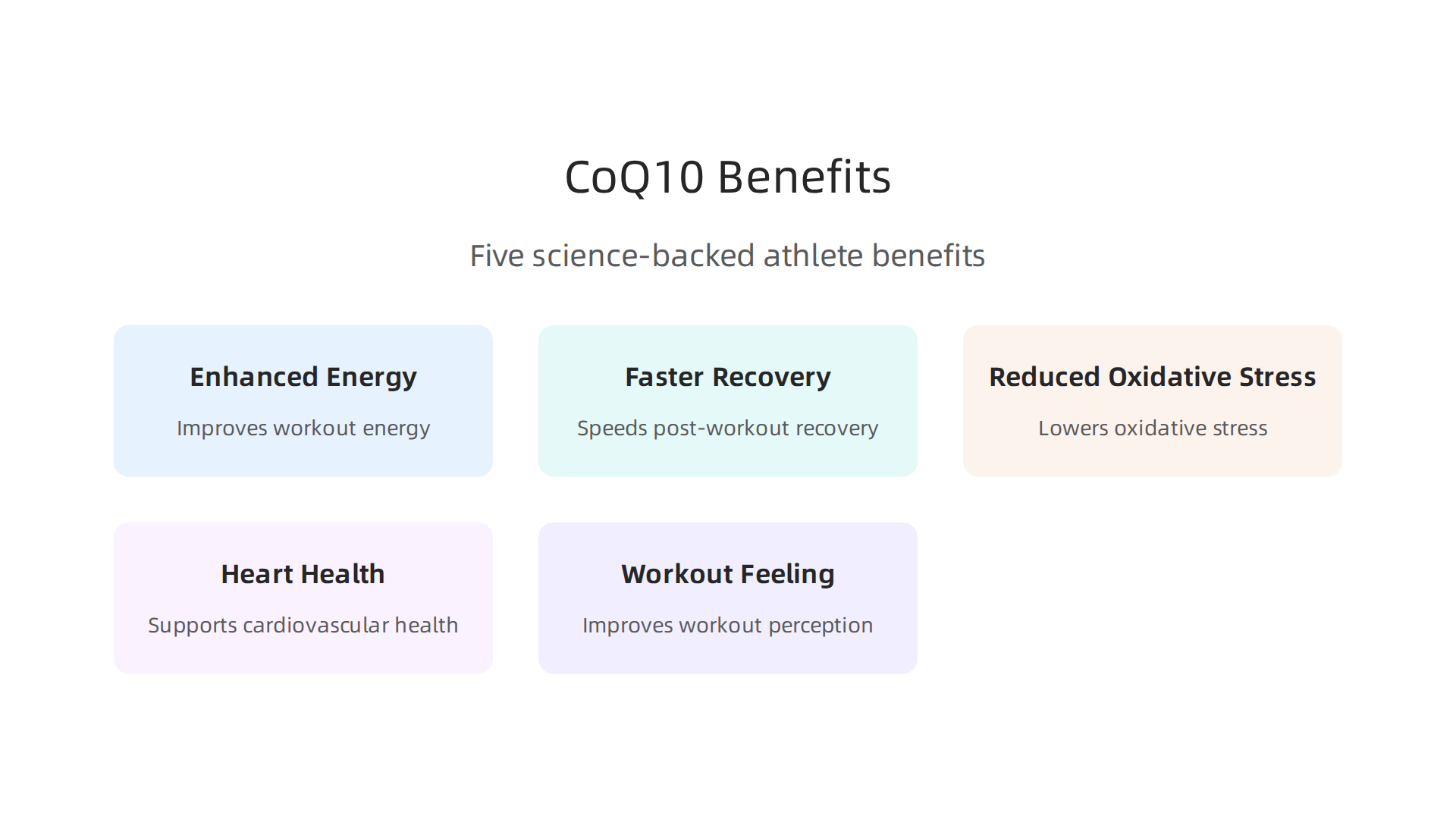
Now you know the difference between ubiquinone and ubiquinol. But why should you care? Because vitamin q10 supplements can actually change how you feel during your workouts and how fast you bounce back afterward. Let me show you what the latest studies say.
Benefit 1: More Energy, Less Fatigue
Every rep, every sprint, every set depends on your cells making energy. CoQ10 is the spark plug for that process. A 2025 review of 24 studies found that CoQ10 supplementation increases blood concentrations and can support exercise performance, especially when your body is under stress (source). That means you feel less drained halfway through your workout.
Benefit 2: Less Oxidative Stress
Hard training creates free radicals. Those little troublemakers damage your cells and slow you down. CoQ10 is a powerful antioxidant that neutralizes them. A 2026 study showed that CoQ10 analogs can prevent exercise-induced oxidative stress and muscle damage (source). Think of it as a shield for your hard-working muscles.
Benefit 3: Faster Recovery After Tough Sessions
You know that soreness that hangs around for days? CoQ10 helps cut it short. A clinical trial looked at how CoQ10 affects recovery after intense exercise.
The results pointed to less muscle impairment and faster return to normal function (source). So you can get back to training sooner without feeling wrecked.
Benefit 4: Stronger Heart Under Pressure
Your heart works hardest when you push your limits. CoQ10 supports cardiovascular health by helping heart cells produce energy and by reducing oxidative stress. A 2026 overview confirmed that CoQ10 plays a key role in enhancing sport performance, partly through better heart function under load (source). For everyday athletes, that means steadier output and less huffing and puffing.
Benefit 5: Better Adaptations to High Intensity Training
Want to get more out of your HIIT sessions? A 2025 study found that combining CoQ10 with high intensity interval training boosted physical adaptations more than training alone (source). Your body actually gets better at using oxygen and recovering between intervals.
Here is the thing. CoQ10 works even better when paired with other nutrients like magnesium supplements for muscle function and vitamin c supplement for absorption. A solid multivitamin supplement can fill in the gaps too.
Ready to feel the difference? Check out our top-rated CoQ10 supplements and start training smarter, not harder.
How to Choose a High-Quality Vitamin Q10 Supplement (Buyer’s Checklist)
Not all CoQ10 products are created equal. After learning about the benefits, you might be ready to buy. But here is the thing. The supplement industry is not tightly regulated. So you need to know what to look for. Let me walk you through a simple checklist so you can pick a vitamin q10 supplement you can actually trust.
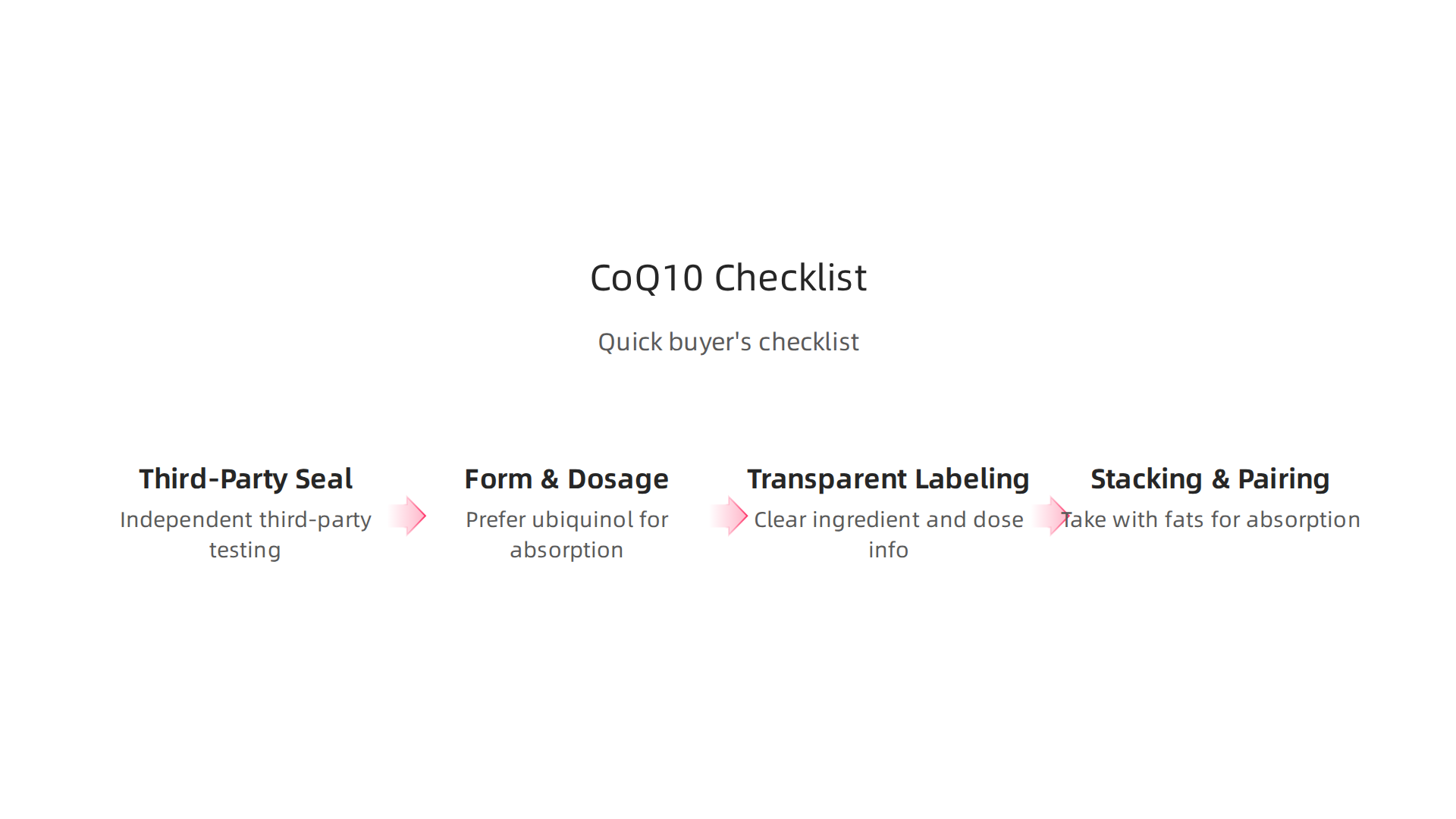
Look for Third-Party Seals First
This is the single most important step. Third-party testing means an independent lab checked the product for purity, potency, and safety. Look for seals from organizations like USP, NSF, or ConsumerLab.
NSF, for example, is one of the only testing organizations that does true independent testing of dietary supplements.
They do not just look at data from the manufacturer (source). When you see an NSF seal, you know someone else verified what is inside the bottle.
A 2026 expert analysis ranked 52 supplement brands based on third-party testing, ingredient quality, and customer results (source). The brands that scored highest all had independent testing. That is your shortcut to quality.
Choose the Right Form and Dosage
You already know about ubiquinone versus ubiquinol from earlier. Here is how to decide.
- Ubiquinone: This is the standard form. It works well for most people and costs less.
- Ubiquinol: This is the active form. It may be better if you are over 40 or have certain health conditions.
A 2026 review of the best ubiquinol supplements pointed out that NSF Certified for Sport certification delivers extra trust for athletes who worry about banned substances (source).
Dosage matters too. Most studies use between 100 mg and 300 mg per day. Start on the lower side and see how you feel.
Check for Transparency
A quality brand will openly share their lab results. Some companies post batch-specific test reports on their websites. Others work with labs like Eurofins to ensure purity and potency in every batch (source).
By 2026, supplement testing has evolved to focus more on traceability and emerging contaminants (source). You want a brand that keeps up with these standards.
Pair It Smartly
CoQ10 works better when taken with healthy fats because it is fat-soluble. Some products also include black pepper extract (piperine) to boost absorption. And do not forget about supporting nutrients.
Pairing your CoQ10 with a multivitamin supplement that contains vitamin b12 supplements or vitamin c supplement can round out your daily nutrition. Magnesium supplements also support the energy pathways that CoQ10 fuels.
My Quick Recommendation
If you want a shortcut through all this research, check out our ranked list of the best CoQ10 options here. We vetted them on testing, form, and real user results so you do not have to guess.
Here is the section "Optimal Dosage, Timing, and Stacking Strategies" written in English and publication-ready.
Optimal Dosage, Timing, and Stacking Strategies
You have chosen your supplement. Now the big question is: how do you take it to get the most out of it? Getting the dosage, timing, and stacking right can make a real difference in how you feel. Let me break it down simply.
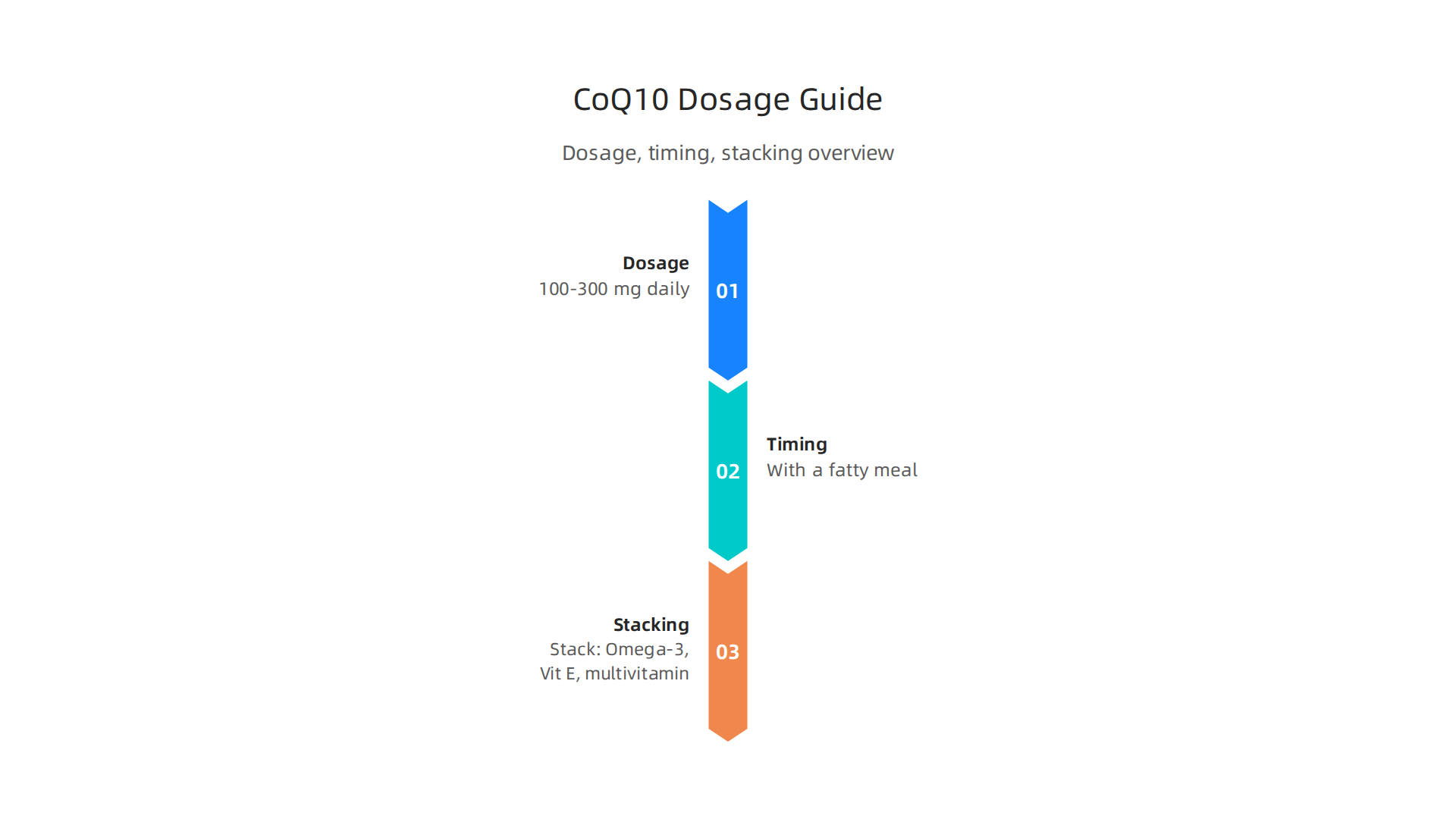
How Much Should You Take?
Most studies use between 100 mg and 300 mg per day. A good starting point is 100 to 200 mg daily. According to the National Institutes of Health, toxicity is very unlikely even up to 1200 mg per day, but most people do not need that much (source). Start low and see how your body responds.
The Mayo Clinic confirms that most healthcare professionals consider CoQ10 safe with few side effects (source). Still, it is always smart to check with your doctor before starting any new vitamin q10 supplements.
When Should You Take It?
Here is a simple rule: take CoQ10 with a meal that contains some fat. Why? Because CoQ10 is fat-soluble. Your body absorbs it much better when you eat it with food.
- Morning or evening? Either works, as long as you take it with a meal.
- Consistency matters. Take it at the same time each day to build a habit.
- Space it out if needed. If you take thyroid medication, you may need to wait at least 4 hours between doses (source). And if you take blood thinners like warfarin, talk to your doctor first because CoQ10 can interact (source).
Stacking It with Other Supplements
CoQ10 works even better when you pair it with the right teammates. This is called stacking. Here are three smart stacks:
- Omega-3s (fish oil): Both support heart health and energy production.
- Vitamin E: This antioxidant helps protect CoQ10 in your body and may boost its effects.
- A daily multivitamin: A good multivitamin supplement fills in the gaps and gives your body the full set of nutrients it needs.
You can also add magnesium supplements to support the energy pathways that CoQ10 fuels. And a vitamin c supplement or vitamin b12 supplements can round out your daily nutrition nicely.
My Practical Takeaway
Remember these three things: start with 100 to 200 mg daily, take it with a fatty meal, and consider stacking with omega-3s and vitamin E for better results. This simple routine can help you get the most from your CoQ10 without overcomplicating things.
If you want a shortcut to the best products, check out our vetted list of top CoQ10 options here. We did the research so you do not have to.
Safety, Side Effects, and Drug Interactions
You have learned how to take CoQ10. But what happens if you take it with other medications? This is a serious question. Let me walk you through what you need to know to stay safe.
Is CoQ10 Actually Safe?
Yes, it is. Most healthcare professionals agree that CoQ10 is very safe with few side effects. According to the Mayo Clinic, most people tolerate it well (source). The National Institutes of Health also confirms that even up to 1200 mg per day, toxicity is unlikely (source).
That said, some people do experience mild side effects. These can include:
- Stomach upset or nausea
- Loss of appetite
- Trouble sleeping (insomnia)
- Headaches or dizziness
These are usually mild and go away as your body adjusts.
The Big One: Drug Interactions
Here is the part you cannot skip. CoQ10 interacts with some common medications. If you take any of these, you must talk to your doctor first.
- Blood thinners (warfarin, Coumadin): CoQ10 can make these drugs less effective. This could raise your risk of blood clots. WebMD lists this as a moderate interaction (source).
- Blood pressure medications: CoQ10 has a mild blood pressure lowering effect. Taking it with your existing meds could drop your pressure too low (source).
- Thyroid medication: CoQ10 can reduce how well your body absorbs thyroid hormones. Space doses apart by at least four hours (source).
- Cancer treatments: Some chemotherapy drugs may be less effective when combined with CoQ10. Always check with your oncologist first.
What About Statins?
Statins are drugs used to lower cholesterol. Research shows they can actually lower your body’s natural CoQ10 levels. This may explain why some people get muscle pain while on statins. Taking a CoQ10 supplement could help, as GoodRx explains (source). But again, talk to your doctor before adding anything new.
The Simple Rule
Treat every supplement like a new prescription. Tell your doctor or pharmacist what you are taking. It is the best way to enjoy the benefits of your vitamin q10 supplements without any risk.

If you want to make sure you are choosing a safe and reliable product, check out our vetted list of top CoQ10 supplements here. We do the research so you can feel confident.
Where to Buy CoQ10 Supplements in 2026: Trusted Channels vs. Red Flags
So you know CoQ10 is safe and you know how to take it. But where do you actually buy it? This matters more than you might think. Not all vitamin q10 supplements are created equal, and some sellers do not have your best interests in mind.
Online vs. Retail: Which Is Better?
Both options have pros and cons. Let me break them down.
Buying online gives you more choices and often better prices. You can read reviews, compare ingredients, and find specialty brands you will never see at a local store. Sites like Healthline recommend shopping from reputable online retailers that offer clear labeling and third-party testing (source).
Buying in person at a pharmacy or health food store lets you see the product before you pay. You can check expiration dates, feel the packaging, and ask a pharmacist questions. But the selection is usually smaller and prices can be higher.
Signs of Low-Quality or Fake Products
Here is where you need to be careful. Some red flags are easy to spot.
- Vague labels that do not list the exact form (ubiquinone or ubiquinol) or dosage
- Unrealistic claims like "cures everything" or "instant energy boost"
- No third-party testing seal from groups like ConsumerLab or USP
- Suspiciously low prices that seem too good to be true
ConsumerLab regularly tests supplements and finds that some products do not contain what their labels promise (source). That is money down the drain.
Direct from Manufacturer vs. Third-Party Retailers
Buying directly from the brand gives you the freshest product and direct customer service. Brands like Pure Encapsulations sell only through their own channels or authorized partners (source).
Third-party retailers like Amazon or iHerb offer convenience and easy returns. But you have to watch out for counterfeit products sold by unauthorized sellers. Stick to the "sold by" section and buy only from the brand’s official storefront.
The Smartest Way to Buy in 2026
Here is my honest advice. Start with a trusted source that does the vetting for you. We have put together a list of top-rated, independently tested vitamin q10 supplements that meet strict quality standards. Check out our vetted CoQ10 recommendations here and skip the guesswork.
Summary
This guide explains how vitamin Q10 (CoQ10) supports energy production, exercise performance, and recovery, and it translates the latest research into practical advice for everyday athletes. It covers what CoQ10 does in your cells, why levels fall with age and intense training, and the difference between ubiquinone and ubiquinol so you can choose the right form. The article summarizes clinical evidence for reduced fatigue, less oxidative stress, faster recovery, and improved cardiovascular support during training. It then gives a clear buyer’s checklist—third‑party testing, dosage guidance, absorption tips, and stacking strategies—and explains safety, common side effects, and key drug interactions to watch. Finally, it outlines where to buy quality products and how to spot low‑quality supplements so you can start CoQ10 safely and effectively.


Get practical training, recovery, and nutrition insights in your inbox